


Barrier-focused face care workflow for healthier skin
TL;DR:
- Canadian winter climate damages skin barrier, causing dryness redness and sensitivity.
- A barrier-first skincare routine with specific ingredients supports skin repair and resilience.
- Avoid over-exfoliation and gradually introduce actives to safely address hyperpigmentation.
Canadian winters are relentless. Between biting wind, indoor heating, and humidity that drops to near zero, your skin takes a serious hit every single day. If you’ve noticed more dryness, redness, or stubborn dark spots in recent years, your skin barrier is likely struggling to keep up. The good news is that a structured, ingredient-led face care workflow can turn things around. In this guide, we walk you through exactly how to rebuild your barrier, layer actives safely, and address hyperpigmentation without making sensitivity worse.
Table of Contents
- Why your skin barrier matters in Canada
- Core morning face care routine: Step-by-step workflow
- Targeting hyperpigmentation safely: Smart ingredient choices
- Troubleshooting: Adjusting your workflow for barrier setbacks and seasonal shifts
- What we’ve learned: Breaking free from the one-size-fits-all face care myth
- Find your perfect barrier-first skincare routine
- Frequently asked questions
Key Takeaways
| Point | Details |
|---|---|
| Barrier focus first | Always repair and strengthen your skin barrier before adding strong actives or brightening treatments. |
| Canadian routines matter | Adapt your skincare to local weather—extra hydration and barrier care in winter and vigilant sun protection in summer. |
| Gentle ingredients succeed | Niacinamide, ceramides, azelaic acid, and stable vitamin C deliver results without irritation, especially for sensitive or darker skin tones. |
| Simplicity wins for setbacks | When your skin acts up, simplify your routine to cleanser, moisturizer, and SPF for rapid recovery. |
Why your skin barrier matters in Canada
Your skin barrier is the outermost layer of your skin, and it does two critical jobs: it keeps moisture locked in and blocks irritants, bacteria, and pollutants from getting through. Think of it as a protective seal. When it’s intact, your skin feels comfortable, looks balanced, and responds well to products. When it’s compromised, everything changes.
Canadian climate conditions are particularly hard on this seal. Cold temperatures cause the lipid matrix (the fatty layer that holds skin cells together) to contract and weaken. Indoor heating strips residual moisture from the air. Wind accelerates water loss from the skin’s surface. The result is a skin barrier that is chronically under stress, especially from October through April.
Signs your barrier may be compromised:
- Persistent tightness or dryness, even after moisturising
- Redness or blotchiness that wasn’t there before
- Flaky patches that don’t respond to regular lotion
- Products that used to feel fine now sting or burn
- Increased sensitivity to temperature changes
If any of these sound familiar, barrier repair needs to come first. Layering brightening serums or exfoliating acids on a damaged barrier will only deepen the problem.
The most effective ingredients for barrier repair include:
| Ingredient | What it does |
|---|---|
| Ceramides | Replenish the lipid matrix, restore the skin’s protective seal |
| Niacinamide | Reduces redness, strengthens barrier, supports even tone |
| Squalane | Lightweight emollient that mimics skin’s natural oils |
| Panthenol | Draws moisture in and soothes inflammation |
For women navigating seasonal skincare in Canada, understanding these ingredients is the starting point. And for a deeper look at how these all work together, our guide on holistic barrier repair covers the full picture.
Remember: You cannot effectively treat hyperpigmentation or sensitivity on a damaged barrier. Repair first, then layer actives.
Core morning face care routine: Step-by-step workflow
Once you appreciate the barrier’s role, building an effective morning routine becomes much clearer. Order matters more than most people realise. Applying products in the right sequence maximises absorption and minimises the risk of irritation.
Here is the AM routine sequence we recommend:
- Gentle cleanser. Use a low-pH, fragrance-free formula. Avoid anything that leaves skin feeling squeaky or tight. Stripping your skin first thing sets a difficult tone for every layer that follows.
- Stable Vitamin C serum. Apply to slightly damp skin and allow 1 to 5 minutes for absorption before moving on. Vitamin C brightens, protects against UV-induced pigmentation, and acts as an antioxidant shield.
- Niacinamide serum (2 to 5%). This workhorse ingredient reduces redness, supports the barrier, and helps even out skin tone over time. It layers well with most other actives.
- Hyaluronic acid. Apply while skin is still slightly damp to draw moisture into the surface layers. In dry Canadian air, this step is non-negotiable.
- Ceramide-rich moisturiser. This seals everything in. Look for formulas that combine ceramides with fatty acids and cholesterol for the most complete barrier support.
- Mineral SPF 30 or higher. This is the final and most critical step. Even in winter, snow reflects up to 80% UV radiation back onto your face.
Pro Tip: If you’re new to Vitamin C, start with a 10% L-ascorbic acid formula and store it in a cool, dark place. Oxidised Vitamin C (when it turns orange or brown) loses its effectiveness entirely.
| Step | Key ingredient | Primary benefit |
|---|---|---|
| Cleanser | Amino acids, gentle surfactants | Removes debris without stripping |
| Vitamin C | L-ascorbic acid (10 to 20%) | Brightening, antioxidant protection |
| Niacinamide | 2 to 5% niacinamide | Barrier support, redness reduction |
| Hyaluronic acid | Multiple molecular weights | Deep and surface hydration |
| Moisturiser | Ceramides, fatty acids | Seals moisture, repairs barrier |
| SPF | Zinc oxide, titanium dioxide | UV protection, pigmentation prevention |
Consistency is everything. Most women see meaningful improvement in their sensitive skin routine results within 4 to 8 weeks. For more on which barrier repair ingredients work best together, we’ve put together a detailed breakdown.
Targeting hyperpigmentation safely: Smart ingredient choices
With a strong foundation set, you can safely address stubborn pigmentation as the next step in your workflow. Hyperpigmentation, including post-inflammatory hyperpigmentation (PIH), forms when melanin production is triggered by inflammation, UV exposure, or barrier damage. The key word there is inflammation. A damaged barrier increases PIH risk because every minor irritation becomes a trigger.
The safest and most effective ingredients for fading dark spots on sensitive skin include:
- Niacinamide (4 to 5%): Interrupts the transfer of melanin (pigment) to skin cells without causing irritation. Ideal for daily use.
- Azelaic acid (10%): Anti-inflammatory and brightening. Particularly effective for PIH and safe for most skin tones.
- Stable Vitamin C: Works at the melanin production stage to prevent spots from forming in the first place.
- Alpha-arbutin: A gentler alternative to hydroquinone, it inhibits the enzyme responsible for melanin synthesis.
According to dermatologists, niacinamide and azelaic acid fade spots with significantly less risk in sensitive or darker skin tones. Over-exfoliating is one of the most common mistakes women make when treating PIH, as it triggers more inflammation and worsens the very spots they’re trying to fade.
| Ingredient | Suitable for sensitive skin | Safe for darker tones | Speed of results |
|---|---|---|---|
| Niacinamide | Yes | Yes | 8 to 12 weeks |
| Azelaic acid | Yes | Yes | 8 to 12 weeks |
| Alpha-arbutin | Yes | Yes | 8 to 12 weeks |
| Vitamin C | Yes (stable forms) | Yes | 8 to 12 weeks |
| Hydroquinone | Use with caution | Requires derm guidance | Faster but riskier |
Pro Tip: Introduce one new active at a time, spaced two weeks apart. This way, if your skin reacts, you’ll know exactly which product caused it.
For a complete breakdown of hyperpigmentation strategies tailored to Canadian skin, and for guidance on soothing sensitive skin while treating pigmentation, we’ve covered both in detail.
Troubleshooting: Adjusting your workflow for barrier setbacks and seasonal shifts
No workflow is perfect. Knowing how and when to adapt ensures barrier health through every season and challenge.
Your skin will tell you when something is off. The most common signs of a barrier breach include:
- Products that previously felt comfortable now sting or burn
- Redness that doesn’t settle within an hour of application
- Dry patches that appear even after moisturising
- Sudden breakouts or increased congestion
When this happens, simplify immediately. A compromised barrier needs rest, not more actives. Follow this reset protocol:
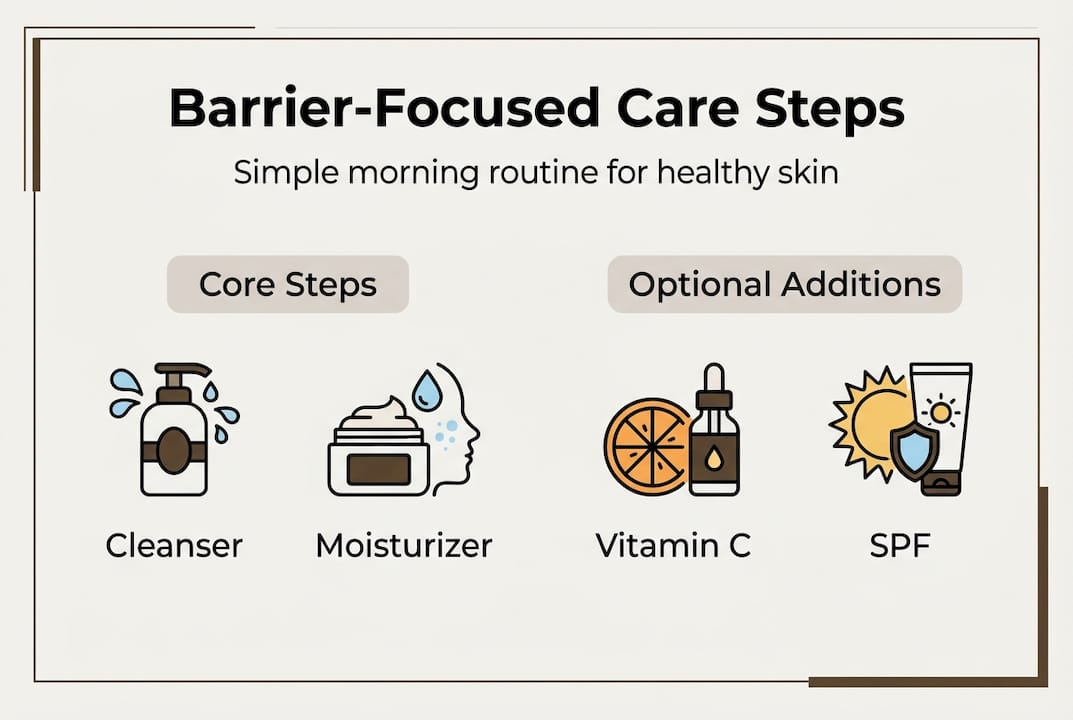
- Strip your routine to three steps: gentle cleanser, barrier moisturiser, and mineral SPF. Nothing else for two to four weeks.
- Reintroduce one product at a time, starting with the gentlest option (niacinamide before Vitamin C, for example).
- Patch test every active on your inner arm for 48 hours before applying to your face.
- Track your skin’s response in a simple notes app or journal to identify patterns.
Pregnancy-safe note: If you’re pregnant, niacinamide and azelaic acid are your safest brightening options. Avoid retinoids, hydroquinone, and high-dose salicylic acid entirely.
Pro Tip: In winter, swap your lightweight moisturiser for a richer emollient formula containing urea or shea butter. In summer, return to lighter textures and increase your SPF application frequency.
Seasonal adaptation is not optional in Canada. Winter demands richer emollients and extra barrier support, while summer calls for stronger antioxidant protection and diligent SPF use. For guidance on selecting the right barrier moisturizer for each season, and for a closer look at emollient solutions that support long-term repair, both resources are worth bookmarking.
What we’ve learned: Breaking free from the one-size-fits-all face care myth
Here’s something we feel strongly about: the skincare industry has a habit of pushing complexity. More steps, stronger actives, faster results. For women living in Canada’s climate, this approach often backfires. We’ve seen it repeatedly. A woman starts a popular 10-step routine, her barrier breaks down, her sensitivity spikes, and her dark spots actually worsen from the inflammation.
The uncomfortable truth is that gentler, barrier-first routines consistently outperform aggressive ones for long-term skin health. Progress looks like improved resilience and comfort over months, not dramatic overnight change. Our perspective, grounded in both formulation science and real customer experience, is that the best routine is the one your skin can actually tolerate through a Canadian February.
For anyone ready to rethink their approach, our piece on holistic repair challenges several popular skincare assumptions worth questioning.
Find your perfect barrier-first skincare routine
You now have the knowledge to build a routine that genuinely works for your skin. The next step is finding products that match your specific concerns, whether that’s dryness, sensitivity, hyperpigmentation, or all three.

At Body Face Scalp™, every product in our skincare collection is formulated with ingredient transparency and barrier repair at the centre. From targeted serums to our barrier restoring moisturiser, each formula is designed to work with your skin’s natural function, not against it. Browse our full range of premium skin care solutions and find the routine that fits your skin, your climate, and your life.
Frequently asked questions
How soon will I see results from a barrier-focused routine?
Most women notice improved moisture and reduced sensitivity within 2 to 4 weeks. Visible tone evening typically follows at the 4 to 8 week mark with consistent daily use.
Do I need different products for winter and summer in Canada?
Yes. Winter calls for richer moisturisers and barrier-boosting emollients, while summer benefits from lighter textures and increased SPF focus. Snow reflects 80% UV even in winter, so SPF is year-round.
What are the safest actives for dark spots on sensitive skin?
Niacinamide and azelaic acid are the gentlest and most effective starting points. Patch test all new products and avoid harsh physical or chemical exfoliants until your barrier is fully stable.
How can I tell if my barrier is damaged?
Look for persistent redness, dryness, and a stinging sensation when applying products that previously felt comfortable. These are reliable early warning signs.