


Best skincare routine for healthy skin: 2026 guide
TL;DR:
- The ideal skincare routine focuses on gentle cleansing, consistent moisturisation, and daily broad-spectrum SPF 30 or higher. Targeted treatments like retinoids and niacinamide can be layered for specific concerns such as acne or hyperpigmentation. Maintaining these core habits with product support fosters healthy, barrier-strong skin over time.
The best skincare routine for healthy skin is defined by three core daily behaviours: gentle cleansing, consistent moisturisation, and broad-spectrum sunscreen application every morning. Dermatological guidance from Harvard Health confirms that fragrance-free moisturisers with hyaluronic acid or glycerin, paired with daily SPF 30 or higher, form the foundation of any optimal skincare routine. Beyond these three steps, targeted treatments such as topical retinoids, niacinamide, or antioxidants can be layered in to address specific concerns including dryness, sensitivity, acne, and hyperpigmentation. What is a skincare routine at its core? It is a repeatable daily regimen that protects, repairs, and maintains your skin barrier over time.
What are the foundational steps in a skincare routine for healthy skin?
A daily skincare regimen built on three non-negotiable steps delivers the most consistent results for the widest range of skin types. These steps are mild cleansing, daily moisturisation, and broad-spectrum sun protection. Every other product you add works better when this foundation is solid.
Gentle cleansing
Cleansing removes excess oil, pollutants, and product residue without disrupting the skin’s natural moisture barrier. Harvard Health advises mild cleansing once daily for most skin types, particularly for those with aging or sensitive skin. Over-cleansing strips the skin of its protective lipids, which triggers compensatory oil production and increases sensitivity. A gentle, pH-balanced cleanser used once in the evening, with a simple water rinse in the morning, is sufficient for most people.

Daily moisturisation
Moisturising seals water into the skin and supports the barrier function that keeps irritants out. Fragrance-free formulas containing humectants like hyaluronic acid (which draws water into the skin) or glycerin (which holds moisture at the surface) are the most universally tolerated. Applying moisturiser to slightly damp skin improves absorption and effectiveness. This step is non-negotiable regardless of skin type, including oily skin, because hydration and oil production are separate functions.
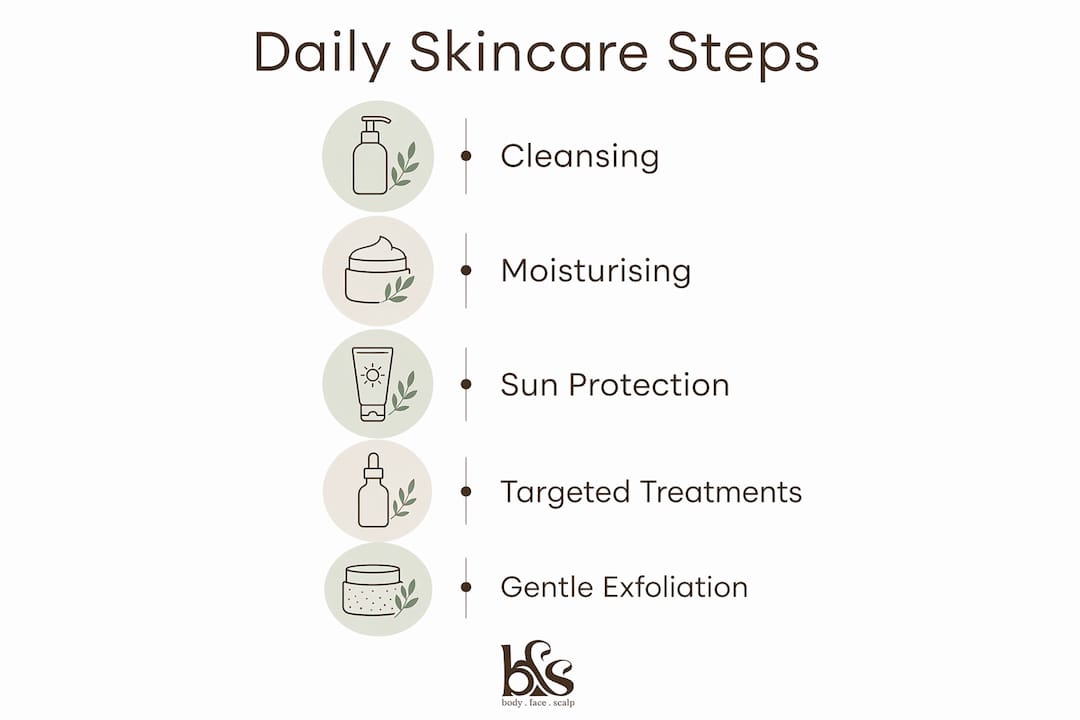
Broad-spectrum sunscreen
Sun protection is the single most evidence-backed step for preventing photoaging, hyperpigmentation, and skin cancer. The AAFP recommends SPF 30 or higher, applied 15 to 30 minutes before sun exposure and reapplied every two hours when outdoors. That reapplication window matters more than most people realise. A single morning application without reapplication provides far less protection than the SPF number suggests.
- Use a gentle, sulphate-free or pH-balanced cleanser morning and evening, or just evenings if your skin is sensitive.
- Apply a fragrance-free moisturiser with hyaluronic acid or glycerin immediately after cleansing.
- Apply broad-spectrum SPF 30 or higher every morning as the final step before leaving the house.
- Reapply sunscreen every two hours when spending time outdoors.
- Choose mineral sunscreens with zinc oxide or titanium dioxide if your skin is reactive or acne-prone.
Pro Tip: Apply your moisturiser while your skin is still slightly damp after cleansing. This traps residual water in the skin and significantly improves hydration compared to applying on completely dry skin.
How to adapt your routine for dryness and sensitivity
Dry and sensitive skin requires a more deliberate approach to barrier repair than the standard three-step routine. The skin barrier in these conditions is compromised, meaning it loses water faster and reacts more readily to external irritants. The goal is to layer moisture consistently throughout the day and choose products that actively support barrier repair rather than simply sitting on the surface.
European atopic eczema guidelines strongly recommend liberal emollient application multiple times daily, particularly after bathing, using what is known as the “soak and seal” method. This technique involves bathing in lukewarm water for five to ten minutes, then immediately applying an emollient-rich moisturiser within three minutes of stepping out. Applying on damp skin seals in the absorbed moisture before it evaporates. This approach is measurably more effective than applying emollients to dry skin later in the day.
For cleanser selection, the same guidelines recommend pH 5 to 6 cleansers and avoidance of alkaline bar soaps, which disrupt the skin’s natural acid mantle and worsen dryness and sensitivity. Look for cleansers labelled as “syndet” (synthetic detergent) bars or gentle gel cleansers with ceramides or oat extract. You can find a detailed product-by-product breakdown in this dry skin routine checklist from Bodyfacescalp.
Here is a practical approach to building a routine for dry or sensitive skin:
- Cleanse with a pH-balanced, fragrance-free cleanser once daily in the evening. In the morning, rinse with lukewarm water only.
- Apply a ceramide-rich or emollient-heavy moisturiser immediately after bathing while skin is still damp.
- Reapply a lighter moisturiser or facial oil at midday if your skin feels tight or uncomfortable.
- Avoid physical scrubs, alcohol-based toners, and any product containing synthetic fragrance or essential oils.
- Introduce any new active ingredient (such as a mild AHA or niacinamide) one at a time, waiting two weeks before adding another.
Pro Tip: If your skin feels tight within 30 minutes of cleansing, your cleanser is too harsh. Switch to a milder formula and your barrier will begin to recover within one to two weeks.
What targeted treatments address acne and hyperpigmentation?
Acne and post-inflammatory hyperpigmentation (the dark spots left behind after breakouts) require specific active ingredients added on top of the foundational routine. The American Academy of Dermatology identifies topical retinoids as cornerstone treatments for acne, working by accelerating cell turnover, unclogging pores, and reducing the formation of new comedones. Retinoids also directly address hyperpigmentation by speeding up the shedding of pigmented skin cells.
Benzoyl peroxide is the most effective over-the-counter antibacterial ingredient for acne and works best in combination with retinoids. Using both together addresses two separate mechanisms: bacterial overgrowth and abnormal cell shedding. The AAD notes that emollients reduce retinoid irritation when used concurrently, which is why barrier support is not optional when you are on an active treatment regimen. Skipping moisturiser while using retinoids is one of the most common reasons people abandon treatment.
Sunscreen is not a finishing touch in an acne and pigmentation routine. It is a clinical requirement. Retinoids increase photosensitivity, and UV exposure directly worsens post-inflammatory hyperpigmentation. Consensus guidance highlights that visible light protection alongside UVA and UVB coverage is critical for treating hyperpigmentation effectively. This means choosing a broad-spectrum sunscreen that also contains iron oxides, which filter visible light. For more on treating dark spots and acne scarring, Bodyfacescalp’s guide on acne scars and dark spots covers the full treatment hierarchy.
| Treatment | Best for | Key consideration |
|---|---|---|
| Topical retinoids (retinol, tretinoin) | Acne, hyperpigmentation, anti-aging | Start low and slow; always pair with SPF |
| Benzoyl peroxide (2.5% to 5%) | Active acne, bacterial overgrowth | Can bleach fabric; use at night |
| Niacinamide (5% to 10%) | Hyperpigmentation, redness, oiliness | Well tolerated; safe to layer with most actives |
| Broad-spectrum SPF with iron oxides | Hyperpigmentation prevention | Non-negotiable when using retinoids or treating pigmentation |
How to structure your morning versus evening routine
The most effective daily skincare regimen separates your routine into two distinct purposes: morning is for protection and hydration, and evening is for cleansing and treatment. This structure prevents active ingredients from interfering with sun protection and allows repair-focused products to work overnight when skin cell turnover is naturally higher.
Morning routine order:
- Rinse with lukewarm water or use a gentle cleanser if needed.
- Apply a hydrating serum with hyaluronic acid or vitamin C (an antioxidant that also brightens skin).
- Follow with a moisturiser suited to your skin type.
- Finish with broad-spectrum SPF 30 or higher as the absolute last step.
Evening routine order:
- Double cleanse if you wear sunscreen or makeup: an oil-based cleanser first, then a gentle water-based cleanser.
- Apply any targeted treatment such as a retinoid, benzoyl peroxide, or a niacinamide serum.
- Follow with a moisturiser or emollient to support the barrier and reduce active ingredient irritation.
- Skip sunscreen at night; it serves no function without UV exposure.
Brown University Health describes morning and evening routines as complementary rather than redundant, with each serving a distinct biological purpose. The morning routine defends; the evening routine repairs. Keeping this distinction clear helps you avoid over-layering products and reduces the risk of irritation from ingredient interactions. For a step-by-step breakdown of how to layer products correctly, Bodyfacescalp’s face care workflow guide is a practical reference.
Harvard Health advises gentle exfoliation once or twice weekly using chemical exfoliants such as lactic acid or glycolic acid rather than physical scrubs, which can cause micro-tears. This step fits best into the evening routine and should never be combined with retinoids on the same night, particularly when you are first introducing them.
Key takeaways
The best skincare routine for healthy skin requires only three daily steps: gentle cleansing, consistent moisturisation, and broad-spectrum SPF 30 or higher, with targeted treatments added based on your specific skin concerns.
| Point | Details |
|---|---|
| Three core steps | Gentle cleansing, daily moisturisation, and SPF 30 or higher form the non-negotiable foundation. |
| Barrier repair for dry skin | Use the soak and seal method with emollients immediately after bathing for maximum hydration. |
| Retinoids for acne and pigmentation | Pair retinoids with emollients to reduce irritation and always combine with broad-spectrum sunscreen. |
| Morning versus evening structure | Morning focuses on protection; evening focuses on cleansing and targeted active treatment. |
| Sunscreen is non-negotiable | SPF protects against photoaging, worsening pigmentation, and retinoid-induced photosensitivity. |
Why consistency beats complexity in skincare
I have seen this pattern repeatedly: someone builds an elaborate ten-step routine, experiences irritation or purging within two weeks, and abandons everything. The result is worse skin than when they started, plus a bathroom shelf full of half-used products. The research is clear that consistent application of three behaviours drives healthy skin aging far more reliably than any sophisticated product stack.
What I find most underappreciated is the relationship between active treatments and barrier support. People treat these as opposing forces. They think moisturising will “dilute” their retinoid or make their acne worse. In practice, balancing active treatments with barrier care is what prevents treatment discontinuation. You cannot get results from a product you stopped using because it was too irritating.
My practical advice: start with the three-step foundation for four weeks before adding anything else. Once your skin is stable, introduce one active ingredient at a time. If you are in Canada, adjust your routine seasonally. Winter air is significantly drier, which means your summer moisturiser will not be sufficient from October through March. And if you are only going to commit to one habit for life, make it sunscreen. Nothing else in your routine will matter as much over a 20-year horizon.
— Mohid
Build your routine with Bodyfacescalp
At Bodyfacescalp, we formulate every product around one principle: your skin barrier is the foundation of everything. Whether you are managing dryness, sensitivity, acne, or hyperpigmentation, our skincare collection is built to support each step of a science-backed daily routine. Our Barrier Restoring Moisturiser is specifically formulated for dry and sensitive skin, using ceramides and humectants to repair and maintain the skin barrier through Canada’s harsh climate conditions. Browse our full range to find targeted solutions matched to your skin concerns, with ingredient transparency and clinical formulation standards you can trust.
FAQ
What is the best skincare routine for healthy skin?
The best skincare routine for healthy skin consists of gentle cleansing, daily moisturisation with a fragrance-free product containing hyaluronic acid or glycerin, and broad-spectrum SPF 30 or higher every morning. Targeted treatments like retinoids or niacinamide can be added based on specific concerns such as acne or hyperpigmentation.
How often should I apply sunscreen in my daily routine?
Apply broad-spectrum sunscreen with SPF 30 or higher every morning 15 to 30 minutes before sun exposure, and reapply every two hours when outdoors. Sunscreen is the most evidence-backed step for preventing photoaging and worsening hyperpigmentation.
What is the best summer skincare routine for healthy skin?
The best summer skincare routine for healthy skin prioritises lightweight hydration and consistent SPF reapplication, since UV intensity and heat increase both sun damage risk and oil production. Swap heavier winter moisturisers for gel-based formulas with hyaluronic acid, and carry a mineral SPF for midday reapplication.
How do I care for dry or sensitive skin without causing irritation?
Use a pH-balanced cleanser, apply an emollient-rich moisturiser immediately after bathing using the soak and seal method, and avoid products containing synthetic fragrance, alcohol, or alkaline soaps. Introduce any new active ingredient one at a time, waiting at least two weeks between additions.
Can I use retinoids if I have acne and dark spots?
Yes. The AAD recommends topical retinoids as a cornerstone treatment for both acne and post-inflammatory hyperpigmentation. Pair retinoids with a gentle moisturiser to reduce irritation, and always apply broad-spectrum sunscreen daily, as retinoids increase photosensitivity.