


Emollients for barrier repair: ingredient-led solutions that work
Not every moisturiser can repair a damaged skin barrier. That is one of the most common misconceptions we see in skincare, and it matters more than most people realise. Your barrier is not just dry; it is structurally compromised, and restoring it requires the right lipid-based ingredients in the right concentrations. Emollients restore barrier function by filling the microscopic gaps between skin cells with fatty acids, ceramides, and cholesterol, reducing water loss and improving texture. This guide walks you through what emollients actually do, which ingredients deliver real results, and how to choose the best formula for sensitive, dry Canadian skin.
Table of Contents
-
Types of emollients: which repairing ingredients make a difference?
-
Clinical evidence: how effective are emollients in barrier repair?
-
Discover premium barrier-repair solutions with Body Face Scalp
Key Takeaways
| Point | Details |
|---|---|
| Barrier repair essentials | Choosing the right emollient—especially ceramide-based—restores hydration and repairs damage for sensitive, dry skin. |
| Smart ingredient choices | Look for formulas with ceramides, cholesterol, and fatty acids; avoid irritants like glycols for sensitive skin. |
| Clinical validation | Canadian and global studies confirm that premium emollients outperform basic ones in barrier protection and repair. |
| Daily application benefits | Apply emollients liberally, especially post-bath, for maximum barrier support and flare prevention. |
What is the skin barrier and why does it matter?
Your skin barrier is the outermost layer of your skin, made up of corneocytes (flattened skin cells) held together by a matrix of lipids. Think of it as a brick-and-mortar wall: the cells are the bricks, and the lipids are the mortar. When that mortar breaks down, the wall becomes porous.
A healthy barrier does two critical things: it keeps moisture locked in and blocks irritants, allergens, and environmental aggressors out. When it is compromised, you feel it immediately.
Common signs of barrier dysfunction include:
-
Persistent redness or flushing
-
Tightness, especially after cleansing
-
Stinging or burning when applying products
-
Increased dryness that does not respond to regular moisturiser
-
Flaking or rough texture
For Canadian women, the barrier faces extra pressure. Cold winters, low indoor humidity, and wind strip lipids from the skin faster than they can be replenished. Understanding your skin barrier is the first step toward protecting it. Recognising the different types of skin barriers also helps you tailor your approach, since not every barrier responds the same way to the same ingredients.
Emollients work by filling gaps between corneocytes with lipids, directly addressing the structural deficit that causes dryness and sensitivity.
How emollients help repair and protect the skin barrier
With an understanding of the barrier, we can explore how emollients fit into restoration. Emollients are lipid-based ingredients that physically fill the spaces between skin cells, restoring the barrier’s ability to hold moisture and resist external triggers.
“Emollients reduce transepidermal water loss (TEWL) and improve skin texture by replenishing the lipid matrix between corneocytes.”
The key rebuilding blocks are:
-
Ceramides: Naturally occurring lipids that make up roughly 50% of the skin’s lipid matrix. They are the most critical component for barrier integrity.
-
Cholesterol: Works alongside ceramides to maintain the correct lipid ratio and fluidity in the barrier.
-
Fatty acids: Provide structural support and help regulate inflammation.
Emollients do not work alone. Basic emollients with humectants and occlusives are the mainstay therapy for dry skin and conditions like atopic dermatitis. Humectants such as glycerol and urea draw water into the skin, while occlusives like petrolatum form a physical seal on top to prevent that water from escaping. Together, they create a layered defence that emollients alone cannot achieve.
For expert-backed sensitive skin solutions, the combination of ceramide-rich emollients with supporting humectants and occlusives is consistently the most effective approach for reducing symptoms like itching, tightness, and redness.
Types of emollients: which repairing ingredients make a difference?
Now, let’s clarify what sets top-tier emollient formulas apart from basic options. Not all emollients are formulated equally, and the difference in results can be significant.
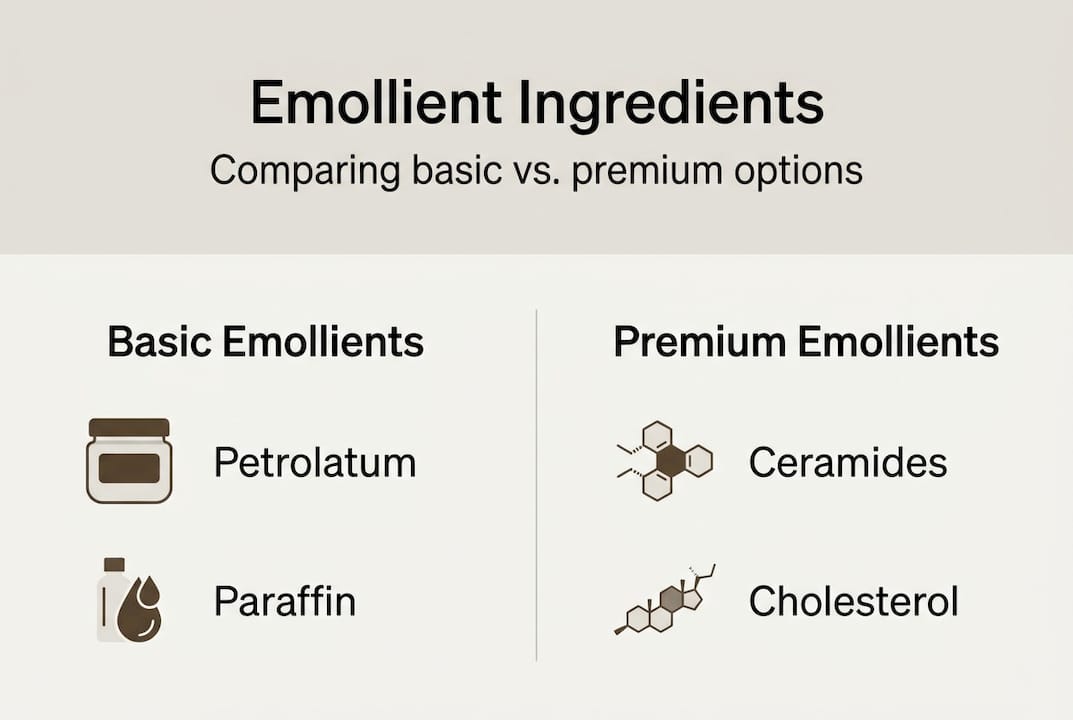
| Feature | Basic emollients | Premium emollients |
|---|---|---|
| Key ingredients | Petrolatum, paraffin | Ceramides, cholesterol, fatty acids |
| Barrier mimicry | Low | High (mirrors natural skin lipids) |
| Hydration duration | Short-term | Up to 72 hours |
| TEWL reduction | Moderate | Up to 92% reduction |
| Sensitivity risk | Low | Very low (when glycol-free) |
| Best for | Mild dryness | Dry, sensitive, or barrier-damaged skin |
Basic emollients like petrolatum and paraffin are safe and affordable. They create a surface seal and offer short-term relief. However, they do not actively rebuild the lipid matrix. For women dealing with persistent dryness or barrier damage, they are often not enough.
Premium formulas containing ceramides, cholesterol, and fatty acids improve hydration up to 72 hours and reduce TEWL by up to 92%. They work because they mimic the skin’s own lipid structure, integrating into the barrier rather than just sitting on top of it.
Ingredients to watch out for:
-
Propylene glycol and butylene glycol: Common in many formulas, but glycols can irritate sensitive skin and should be avoided if your barrier is already compromised.
-
Fragrance and essential oils: Frequent triggers for reactive skin.
-
Alcohol-based ingredients: Can further disrupt the lipid matrix.
Pro Tip: Look for formulas that contain ceramides, cholesterol, and fatty acids in a roughly 1:1:1 ratio. This mirrors the natural composition of your skin’s lipid matrix and delivers the most effective repair. Our guide to barrier-restoring moisturisers breaks this down further, and our sensitive skin routine tips can help you build a complete approach.
Clinical evidence: how effective are emollients in barrier repair?
To put ingredient choices into context, let’s look at what well-designed studies and Canadian guidelines actually show.
The evidence is clear and consistent. Here are the key findings:
-
Hydration and TEWL: Ceramide-based lotions maintain hydration for 24 hours or more and reduce TEWL significantly, with some formulas achieving up to 92% reduction in water loss.
-
Flare prevention: Glycerol-based emollients improved stratum corneum hydration and barrier function compared to control groups in clinical trials, reducing the frequency of flares in atopic dermatitis.
-
Symptom reduction: Regular emollient use reduces itch, scaling, and redness in both atopic dermatitis and general dry or sensitive skin conditions.
-
Prevention: Daily emollient use in high-risk infants reduced atopic dermatitis incidence by 16%, demonstrating a preventive as well as a restorative role.
Key statistic: Ceramide lotions have been shown to reduce TEWL by up to 92% in clinical settings. That is not a marginal improvement; it is a structural shift in how well your skin holds onto moisture.
Canadian guidelines recommend daily, liberal emollient application, multiple times per day, particularly after bathing, to restore the barrier and prevent flares. This is not optional maintenance; it is the foundation of effective barrier care.
For a broader perspective on holistic barrier repair approaches, combining emollients with lifestyle and environmental adjustments produces the most lasting results.
Expert-led strategies for choosing and using emollients
Building on the clinical evidence, here are expert-backed ways to get the best results from your barrier repair routine.
How to choose the right emollient:
-
Read the ingredient list. Prioritise ceramides, cholesterol, and fatty acids near the top.
-
Avoid propylene glycol and butylene glycol if your skin is reactive.
-
Skip fragrances, essential oils, and high-alcohol formulas.
-
Choose products labelled fragrance-free, not just unscented.
How to apply for maximum benefit:
-
Apply immediately after bathing, while your skin is still slightly damp. This locks in moisture before it evaporates.
-
Use a generous amount. Thin applications do not provide adequate barrier coverage.
-
Apply at least twice daily. Liberal post-bath application is consistently recommended for sensitive and dry skin to prevent relapse.
-
Adjust frequency by season. Canadian winters demand more frequent application than summer months.
-
Layer strategically: humectant serum first, then your ceramide-rich emollient, then an occlusive if needed for very dry skin.
Pro Tip: If your skin stings when you apply your emollient, that is a sign your barrier is significantly compromised. Switch to a ceramide-only formula with no added actives until your barrier stabilises.
Ceramide-rich premium formulas that mimic the skin’s natural lipid composition consistently outperform basic options for women with dry or sensitive skin. Adjusting your routine for Canadian seasonal changes is equally important, and pairing your emollient with a well-structured face care routine ensures every step supports barrier health.
Discover premium barrier-repair solutions with Body Face Scalp
If you are ready to apply these insights, we have made it straightforward. At Body Face Scalp, we formulate every product around the science of barrier repair, using ceramide-rich, ingredient-led formulas designed specifically for Canadian skin conditions.

Our Barrier Restoring Moisturizer is built on the ceramide, cholesterol, and fatty acid framework discussed throughout this article, delivering clinically supported hydration and repair without irritating additives. You can explore our full barrier-focused skincare collection to find targeted solutions for your face, body, and scalp. To learn more about our approach and values, visit Body Face Scalp and see how ingredient-led formulation translates into real results for dry, sensitive, and barrier-damaged skin.
Frequently asked questions
Can emollients really repair a damaged skin barrier?
Yes. Emollients restore barrier function by replenishing the lipid matrix between skin cells, with ceramide-rich formulas showing the strongest clinical results for dry and sensitive skin.
How often should I apply emollients for best results?
Apply liberally several times daily, especially right after bathing. Canadian guidelines recommend this frequency to maintain barrier hydration and prevent flares.
Are all emollients safe for sensitive skin?
Most are safe, but glycols can irritate sensitive skin and should be avoided. Choose fragrance-free, glycol-free ceramide formulas for the lowest risk of irritation.
Do premium emollients work better than basic ones?
Clinical evidence shows that ceramide-rich formulas improve hydration up to 72 hours and reduce water loss far more effectively than basic petrolatum or paraffin options, making them the better choice for barrier-damaged skin.