


Fine lines and wrinkles prevention: your 2026 guide
TL;DR:
- Consistent use of daily SPF 30+ is the most impactful step to prevent up to 80% of visible skin aging caused by UV radiation. Incorporating retinoids, antioxidants, and barrier repair ingredients into a routine maintains skin resilience and slows wrinkle formation over time. Extending sun protection and skincare efforts to the neck and décolletage enhances long-term anti-aging results.
Fine lines and wrinkles prevention is defined as the consistent, science-backed practice of protecting skin from UV damage, maintaining barrier integrity, and using evidence-based ingredients to slow visible ageing. UV radiation causes up to 80% of visible skin ageing, making daily broad-spectrum SPF 30+ the single most impactful step you can take. Ingredients like retinoids, vitamin C, niacinamide, and ceramides form the foundation of any effective anti-ageing skincare routine. Brands like SkinCeuticals and Kiehl’s have built entire product lines around these actives, but the ingredient quality and your consistency matter far more than the label. At Bodyfacescalp, we believe prevention is achievable for every skin type when you understand what your skin actually needs.
What causes fine lines and wrinkles, and why prevention matters
Fine lines form when collagen and elastin fibres in the dermis break down faster than your skin can repair them. Two distinct processes drive this: intrinsic ageing, which is the natural, genetically programmed slowdown in cell turnover and collagen production that begins in your late twenties, and extrinsic ageing, which is caused by UV radiation, pollution, smoking, and repetitive muscle movement.

UV radiation accelerates collagen breakdown and elasticity loss, accounting for the majority of the visible ageing most women notice in their thirties and forties. This is not a gradual, invisible process. Sun damage accumulates silently for years before surfacing as deepened lines, uneven texture, and loss of firmness.
A compromised skin barrier causes increased transepidermal water loss and chronic low-grade inflammation, both of which make fine lines more pronounced and slow your skin’s ability to recover from daily damage. Think of your barrier as the foundation of healthy skin. When it is intact, your skin stays plump and resilient. When it is weakened by harsh cleansers, over-exfoliation, or environmental stress, lines deepen faster.
The key drivers of premature ageing include:
- UV radiation — the leading cause of collagen degradation and pigmentation changes
- Smoking — reduces blood flow and depletes vitamin C, accelerating skin thinning
- Air pollution — generates free radicals that oxidise skin proteins
- Repetitive facial movements — create dynamic wrinkles along expression lines over time
- Barrier disruption — from over-cleansing, strong actives, or climate extremes
Early intervention matters because dynamic wrinkles (the kind that appear only when you move your face) become static wrinkles (present even at rest) once collagen loss reaches a threshold. Prevention keeps them in the dynamic stage far longer.
How to build a prevention skincare routine: ingredients and application
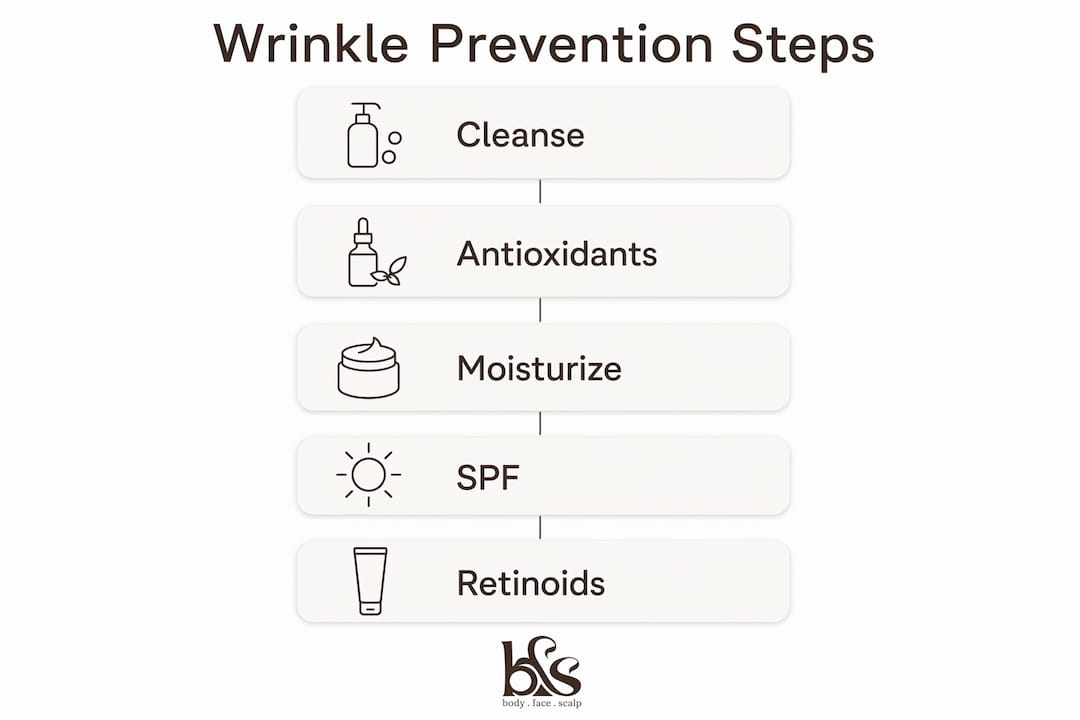
The most effective wrinkle prevention routine is built on four pillars: sun protection, retinoids, antioxidants, and barrier repair. Each pillar addresses a different mechanism of ageing, and together they cover the full spectrum of prevention.
-
Daily broad-spectrum SPF 30+. This is non-negotiable. Apply it as the final step of your morning routine, every single day, regardless of weather or season. Mineral options like zinc oxide sit on the skin surface and reflect UV rays immediately. Chemical filters like avobenzone absorb and neutralise them. Either works; the one you will actually use consistently is the right choice.
-
Retinoids. Retinoids stimulate collagen synthesis and accelerate cell turnover, making them the gold standard for wrinkle prevention. Start with a low-concentration retinol (0.025% to 0.05%) two nights per week, then build frequency over six to eight weeks. Prescription tretinoin delivers faster results but requires a dermatologist’s guidance. Always pair retinoid use with SPF the following morning.
-
Antioxidants. Vitamin C and niacinamide reduce free radical damage and support collagen production over time. Apply a vitamin C serum (L-ascorbic acid at 10% to 20%) in the morning before SPF. Niacinamide works well morning or evening and also strengthens the barrier. Coenzyme Q10 (CoQ10) is a gentler antioxidant suited to sensitive skin types.
-
Barrier repair and hydration. Hyaluronic acid draws moisture into the skin. Ceramides seal it in. Peptides signal the skin to produce more collagen. A moisturiser containing all three addresses hydration and structural support simultaneously. Moisturisers temporarily plump and smooth fine lines, though they work best as part of a broader routine rather than as a standalone fix.
Pro Tip: Layer your products from thinnest to thickest consistency: cleanser, toner (if used), antioxidant serum, moisturiser, SPF. Applying a richer product before a thinner one blocks absorption. Use a gentle, sulphate-free cleanser morning and evening to avoid stripping your barrier before actives are applied.
For a detailed 2026 skincare routine framework, Bodyfacescalp has outlined the full step-by-step approach for barrier-focused skin health.
Summer skincare adjustments for wrinkle prevention
Summer does not mean pausing your prevention routine. It means adapting it. Heat, humidity, and increased UV intensity create specific challenges that require targeted adjustments to protect your progress.
The most common mistake is stopping retinoid use in summer out of fear of sun sensitivity. Retinoids should not be paused when SPF is applied consistently. The solution is diligent daily sunscreen use, not abandoning your most effective anti-ageing ingredient. If you experience increased sensitivity, reduce frequency rather than stopping entirely.
Summer-specific adjustments to consider:
- Switch to a lighter moisturiser texture. Gel-based or water-gel formulas deliver hydration without the heaviness that can feel uncomfortable in heat and humidity. Look for hyaluronic acid and glycerin as primary humectants.
- Double cleanse in the evening. An oil-based cleanser removes sunscreen, sebum, and pollution effectively before your water-based cleanser clears the rest. This prevents congestion and keeps your barrier clear for actives.
- Reapply SPF every two hours when outdoors. A single morning application does not provide all-day protection. SPF sticks or powder formulas make reapplication practical over makeup.
- Add physical protection. Wide-brimmed hats, UV-protective clothing (UPF 50+), and sunglasses reduce cumulative UV exposure on the face, neck, and chest.
- Postpone aggressive treatments. Avoid laser and chemical peel treatments during summer months to prevent UV interference with healing. Schedule these procedures in autumn or winter instead.
| Season | Moisturiser texture | Retinoid frequency | SPF priority |
|---|---|---|---|
| Summer | Gel or water-gel | Maintain, reduce if sensitive | Reapply every 2 hours outdoors |
| Winter | Richer cream or balm | Increase gradually | Daily, even on overcast days |
Pro Tip: In summer, store your vitamin C serum in the refrigerator. Heat and light degrade L-ascorbic acid quickly, reducing its effectiveness. A cool, dark environment extends potency and gives your skin a refreshing application experience.
Why your neck and décolletage need the same attention
The neck and décolletage are the most overlooked areas in any anti-ageing skincare routine, and they show age faster than the face for one structural reason: the skin there is thinner, produces less sebum, and has fewer oil glands to maintain natural moisture. Crepiness, horizontal neck lines, and chest wrinkles often appear years before comparable changes on the face.
Extending antioxidant serums and sunscreen to the neck and décolletage daily is a straightforward habit that pays significant dividends over time. The same ingredients that protect your face protect these areas. The application simply needs to extend further down.
Practical steps for neck and chest care:
- Apply your vitamin C serum from the jawline down to the chest every morning
- Use a slightly richer moisturiser on the neck and décolletage than on the face, since these areas lack the oil production to compensate for dryness
- Apply SPF 30+ to the full neck and chest, not just the face
- Introduce retinoids to the neck gradually, starting once weekly, as the skin there can be more reactive
Pro Tip: When applying moisturiser or serum to the neck, use upward strokes from the collarbone toward the jaw. This gentle technique supports lymphatic drainage and avoids pulling on already-thin skin.
For more on barrier repair strategies that apply to both the face and body, Bodyfacescalp has a dedicated resource covering ten proven methods.
How to evaluate anti-aging products: what works and what does not
The anti-ageing skincare market is saturated with claims that outpace the evidence. Understanding how to read those claims protects your time, money, and skin.
| Product type | What it can realistically do | What it cannot do |
|---|---|---|
| Over-the-counter retinol | Improve texture, reduce fine lines over months | Match prescription tretinoin speed |
| Vitamin C serum | Brighten, protect from free radicals, support collagen | Reverse deep structural wrinkles |
| Peptide moisturiser | Signal collagen production, improve firmness gradually | Replicate injectable results |
| Injectables (Botox, fillers) | Immediately relax or fill wrinkles | Prevent new damage without skincare support |
Many cosmetic anti-ageing products lack the clinical testing required of prescription treatments. This does not mean they are ineffective. It means effectiveness depends on ingredient quality, concentration, and your consistency of use. A well-formulated drugstore retinol used nightly will outperform an expensive cream with no active ingredients.
Price and brand prestige do not guarantee results. The ingredient list does. Look for products where retinoids, vitamin C, niacinamide, ceramides, or peptides appear in the first five to seven ingredients. Anything listed near the bottom of the label is present in trace amounts unlikely to produce meaningful change.
Effective wrinkle prevention relies on consistent application over time rather than expensive brands or hype. Professional treatments like energy-based therapies (radiofrequency, microneedling) and injectables complement a strong skincare routine but do not replace it. The best candidates for in-office procedures are those who already maintain a consistent prevention routine and want to address specific concerns that topicals cannot fully resolve. For a step-by-step anti-ageing routine framework, external resources can offer additional practical guidance.
Key takeaways
Consistent, ingredient-led skincare with daily SPF 30+ is the most effective approach to fine lines and wrinkles prevention, delivering measurable results when applied to the face, neck, and décolletage over time.
| Point | Details |
|---|---|
| SPF is the foundation | UV radiation causes up to 80% of visible ageing; daily SPF 30+ is non-negotiable. |
| Retinoids are the gold standard | Use consistently year-round with SPF; reduce frequency rather than stopping in summer. |
| Barrier health drives results | Ceramides, hyaluronic acid, and peptides maintain plump, resilient skin and slow line formation. |
| Extend your routine downward | Neck and décolletage need the same antioxidants, moisturiser, and SPF as your face. |
| Ingredients over price | Effectiveness comes from active ingredient quality and consistency, not brand prestige. |
Wrinkle prevention in real life: what I have learned
The most honest thing I can tell you about wrinkle prevention is that the gap between knowing what to do and actually doing it consistently is where most routines fall apart. We all know SPF matters. We all know retinoids work. The challenge is building a routine that holds up on a Tuesday morning when you are running late, or on a summer holiday when your usual products are not in your bag.
What I have found actually works is simplification. A three-step morning routine (vitamin C serum, moisturiser, SPF) and a two-step evening routine (gentle cleanser, retinoid or barrier moisturiser) is far more sustainable than a ten-step programme that gets abandoned by week three. Consistency matters more than perfection; gradual improvements build long-term skin resilience.
I also think the industry undersells how much barrier health matters relative to actives. Most women in their thirties and forties are reaching for stronger retinoids or more potent vitamin C when their skin is actually telling them it needs repair first. A disrupted barrier makes every active less effective and every line more visible. Learning to protect and repair your skin barrier is not a passive step. It is the prerequisite for everything else to work.
There is no one-size-fits-all routine. Your skin in a Canadian winter is not the same skin you have in July. Adjusting your routine seasonally is not inconsistency. It is intelligence. The goal is long-term skin health, and that requires paying attention to what your skin is telling you rather than following a fixed protocol regardless of how your skin responds.
— Mohid
How Bodyfacescalp supports your prevention routine

At Bodyfacescalp, we formulate with barrier health and long-term skin resilience as the starting point, not an afterthought. Our Barrier Restoring Moisturiser combines ceramides, hyaluronic acid, and peptides to repair and maintain the skin barrier that keeps fine lines from deepening. For targeted collagen support, the Luster Booster Multi-Peptide Serum delivers a concentrated blend of peptides that signal firmer, more resilient skin over time. Both products are designed for ingredient-conscious women who want results without compromise. Explore the full skincare collection to build a routine that works for your skin, your climate, and your life.
FAQ
What is the most effective step for preventing fine lines?
Daily broad-spectrum SPF 30+ is the single most impactful wrinkle prevention step, as UV radiation causes up to 80% of visible skin ageing. Pairing SPF with a retinoid in your evening routine addresses both protection and active repair.
Can I use retinoids in summer without causing damage?
Yes. Retinoids should not be paused in summer as long as you apply SPF consistently every morning. If sensitivity increases, reduce application to two or three nights per week rather than stopping entirely.
Do expensive anti-ageing creams work better than affordable ones?
Not necessarily. Many cosmetic anti-ageing products lack strict clinical testing, so effectiveness depends on ingredient quality and concentration rather than price. Check that actives like retinol, niacinamide, or ceramides appear near the top of the ingredient list.
Should I apply skincare products to my neck and chest too?
Yes. The neck and décolletage have thinner skin with fewer oil glands, making them prone to early ageing. Extend your antioxidant serum, moisturiser, and SPF to these areas daily for consistent protection.
How long does it take to see results from a prevention routine?
Most ingredient-led routines show measurable improvement in texture and fine lines within eight to twelve weeks of consistent use. Retinoids typically require three to six months to demonstrate their full collagen-stimulating effect.