


Holistic barrier repair for resilient Canadian skin in 2026
Many skincare routines focus almost entirely on hydration, layering on serums and moisturisers without addressing the real root cause of dryness and sensitivity. The truth is, dryness and sensitivity are often structural barrier issues, not simply a lack of water. For Canadian women navigating cold winters, dry indoor air, and dramatic seasonal shifts, this distinction matters enormously. Holistic barrier repair targets the underlying architecture of your skin, delivering lasting improvements that hydration alone simply cannot achieve. In this article, we walk you through exactly what that means and how to apply it.
Table of Contents
- What is the skin barrier and why does it matter?
- Holistic barrier repair versus traditional approaches
- Key components of holistic barrier repair
- Distinguishing dehydration, structural damage, and chronic issues
- How to implement holistic barrier repair in daily Canadian skincare
- Explore premium barrier-focused skincare solutions
- Frequently asked questions
Key Takeaways
| Point | Details |
|---|---|
| Structural repair matters | Fixing dryness and sensitivity requires rebuilding the skin’s lipid matrix, not just adding moisture. |
| Proper lipid ratios | Clinical evidence shows 3:1:1 or 1:1:1 ratios of ceramides, cholesterol, and fatty acids accelerate barrier recovery. |
| Acid mantle and microbiome | Balanced pH and supporting healthy bacteria make barrier repair long-lasting and effective for chronic concerns. |
| Daily routine upgrade | Starting a holistic barrier repair routine improves skin resilience and appearance in as little as four weeks. |
| Canadian climate adaptation | Barrier-focused strategies are essential for women in Canada facing environmental stress and dryness. |
What is the skin barrier and why does it matter?
Your skin barrier is the outermost layer of your skin, and it functions as your body’s first line of defence. Think of it as a protective shield: it keeps moisture locked in and keeps environmental irritants, pollutants, and pathogens out. When it works well, your skin feels comfortable, looks even, and resists sensitivity. When it breaks down, you notice tightness, flaking, redness, and persistent dryness.
The barrier’s brick-and-mortar structure consists of corneocytes (the “bricks”) held together by a lipid matrix (the “mortar”) made up of ceramides, cholesterol, and fatty acids. The typical composition looks like this:
- Ceramides: approximately 50% of the lipid matrix
- Cholesterol: approximately 25%
- Fatty acids: approximately 15 to 20%
When any of these components are depleted, the matrix weakens. Moisture escapes more easily, a process called transepidermal water loss (TEWL), and irritants penetrate more readily. Understanding your skin barrier types helps you identify which repair strategy suits you best.
Canada’s climate makes this especially relevant. Harsh winters strip lipids from the skin’s surface, while dry indoor heating accelerates TEWL. Summer UV exposure and humidity fluctuations add further stress. Learning about protecting your skin barrier is not optional for Canadian skin — it is essential.
Your skin barrier is the foundation of healthy skin. Without structural integrity, no amount of hydration will deliver lasting results.
Holistic barrier repair versus traditional approaches
Traditional moisturisers are designed to hydrate. They draw water into the skin using humectants like hyaluronic acid or glycerin, and they may seal that moisture in with occlusives like petrolatum. This is useful, but it is not the same as repairing the barrier’s structure.
Holistic barrier repair goes further. It replenishes the structural lipids your skin has lost, restores the acid mantle (your skin’s natural pH of 4.5 to 5.5), and supports the skin’s microbiome, the community of beneficial bacteria that helps regulate immunity and inflammation. The difference in outcomes is significant.
| Approach | What it does | Lasting results? |
|---|---|---|
| Hydration only | Adds water temporarily | No |
| Occlusive slugging | Seals surface moisture | Partial |
| Holistic barrier repair | Replenishes lipids, restores pH, supports microbiome | Yes |
Ceramide formulas offer 2x faster recovery compared to hydrating-only products, and biomimetic approaches consistently outperform slugging for long-term barrier health. Furthermore, a 3:1:1 lipid ratio of ceramides to cholesterol to fatty acids accelerates barrier recovery by 40%.
Our barrier restoring moisturiser guide breaks down exactly what to look for in a formula. For a broader view of holistic skincare approaches, we cover the full picture on our blog.
Pro Tip: If your skin feels tight again within hours of moisturising, that is a sign you are hydrating without repairing. Switch to a ceramide-rich formula with the full lipid trio.
Key components of holistic barrier repair
Holistic barrier repair is not a single ingredient or product. It is a system. Here are the four pillars that drive real results:
- Structural lipid replenishment: Your formula must contain ceramides, cholesterol, and fatty acids in ratios that mimic your skin’s natural composition, such as 3:1:1 or 1:1:1, to support lamellar organisation (the orderly layering of lipids that gives the barrier its strength).
- Acid mantle restoration: Your skin’s ideal pH sits between 4.5 and 5.5. Products that are too alkaline disrupt this balance, impairing enzyme activity and reducing the effectiveness of actives like niacinamide. A neutral pH actually doubles niacinamide permeation, making pH management a practical concern, not just a theoretical one.
- Microbiome support: Postbiotics (beneficial byproducts of bacterial activity) help calm persistent sensitivity and reduce inflammation. If your skin reacts to almost everything, microbiome disruption may be a contributing factor.
- Ingredient selection: Avoid fragrances, denatured alcohols, and harsh surfactants. These are common barrier disruptors found in many mainstream products.
The clinical evidence supports this approach clearly. A NMF and lipids moisturiser increased filaggrin (a key structural protein) by 77%, hyaluronic acid by 157%, and lipids by 30%, while reducing TEWL in sensitive skin over four weeks. Importantly, ceramides alone are insufficient — the full lipid trio is required for genuine structural repair.
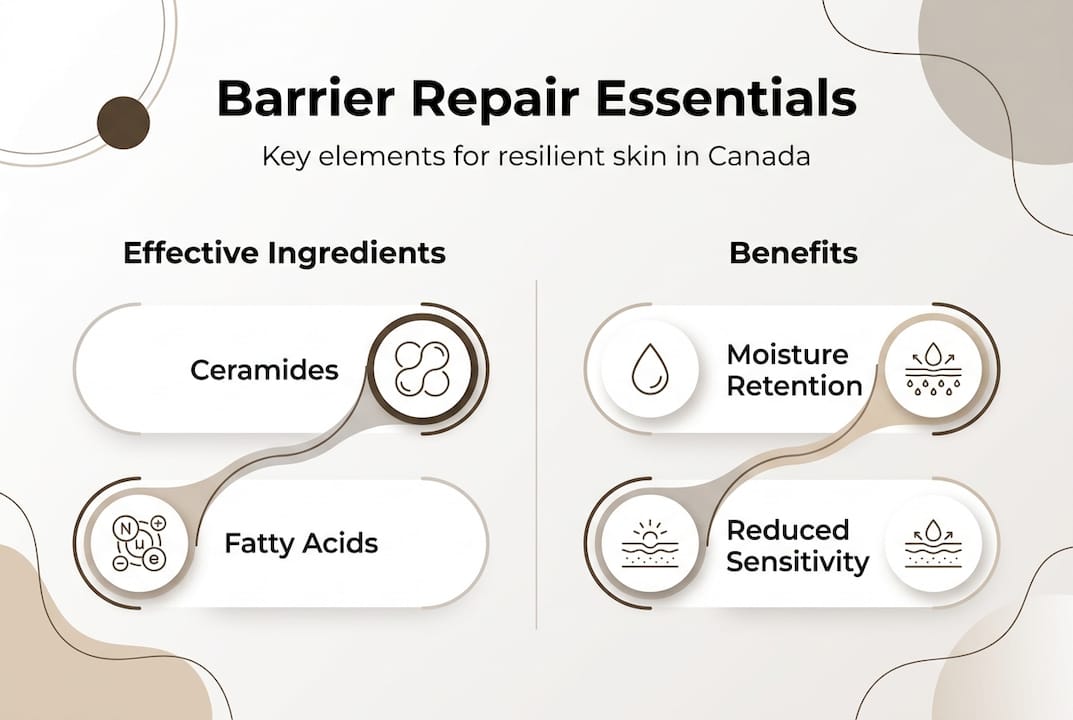
| Ingredient | Role in barrier repair | Found in effective formulas? |
|---|---|---|
| Ceramides | Restore lipid matrix | Essential |
| Cholesterol | Supports lamellar structure | Essential |
| Fatty acids | Fill gaps in lipid bilayer | Essential |
| Postbiotics | Calm microbiome, reduce sensitivity | Recommended |
| Niacinamide | Brightens, supports barrier at correct pH | Beneficial |
For tailored guidance, explore our sensitive skin solutions and our step-by-step routine for sensitive skin.
Pro Tip: When reading ingredient labels, look for all three lipids listed within the first ten ingredients. If only ceramides appear, the formula may not deliver full structural repair.
Distinguishing dehydration, structural damage, and chronic issues
Not every skin concern requires the same solution. Understanding what you are actually dealing with helps you choose the right approach.
- Dehydration is a temporary state. Your skin lacks water, often due to weather, travel, or insufficient water intake. It typically resolves quickly with a good humectant and some patience.
- Structural barrier damage is different. The lipid matrix is impaired, and moisture escapes continuously regardless of how much you hydrate. This requires targeted lipid replenishment, not just more water.
- Chronic or persistent symptoms — ongoing redness, sensitivity to most products, recurring irritation — often point to microbiome disruption. These cases benefit most from postbiotic and microbiome-targeted treatments.
Key signs that your barrier is structurally compromised include:
- Persistent tightness, even after moisturising
- Visible flaking or rough texture
- Stinging or burning when applying products
- Redness that does not resolve between seasons
Dehydration rebounds fast, but structural damage requires consistent lipid replenishment over weeks. Chronic cases benefit most from microbiome-targeted treatments alongside lipid repair.
If your skin reacts to products it once tolerated, that is a strong signal of structural damage, not just sensitivity.
Canada’s seasonal extremes make this distinction especially important. Our guide to seasonal skincare for sensitivity helps you adapt your routine as conditions change. For broader support, Body Face Scalp offers resources built specifically for Canadian skin.
How to implement holistic barrier repair in daily Canadian skincare
Building a holistic barrier repair routine does not require a complete overhaul. It requires the right priorities. Here is how to start:
- Choose a barrier-focused moisturiser that contains ceramides, cholesterol, and fatty acids. Look for the full lipid trio, not just ceramides alone. Our barrier restoring moisturiser is formulated with this in mind.
- Use pH-balanced cleansers and toners. Harsh cleansers strip the acid mantle and set back your repair progress. Aim for products with a pH between 4.5 and 5.5.
- Add a postbiotic or microbiome-friendly active if you experience persistent sensitivity or react to most products. This supports the skin’s immune regulation from within.
- Eliminate known disruptors. Fragrances, denatured alcohols, and sulphate-heavy cleansers are common culprits. Simplify your routine before adding new actives.
- Commit to the full cycle. Barrier turnover takes 28 to 40 days, and clinical evidence shows sustained hydration and barrier improvement with consistent daily use. Do not judge results in the first week.
Pro Tip: Apply your barrier moisturiser within two minutes of cleansing, while skin is still slightly damp. This helps humectants draw moisture into the skin before TEWL accelerates.
Canada’s winters are long and unforgiving. A routine built on structural repair, not just hydration, is what keeps your skin resilient through every season.
Explore premium barrier-focused skincare solutions
If you are ready to move beyond surface-level hydration and invest in real barrier repair, we have built our entire line around this philosophy. At Body Face Scalp, every formula is designed to replenish structural lipids, restore your acid mantle, and support long-term skin resilience — specifically for Canadian conditions.

Browse our premium skincare collection to find formulas that match your skin’s specific needs. Our barrier repair moisturiser delivers the full ceramide, cholesterol, and fatty acid trio in clinically supported ratios. As a Canadian barrier repair brand, we understand what your skin faces through every season, and we formulate accordingly. Your skin deserves more than temporary relief — it deserves structural support that lasts.
Frequently asked questions
How can I tell if my skin barrier is damaged?
Barrier function loss shows up as persistent dryness, sensitivity, flaking, tightness, and ongoing redness or irritation that does not resolve with standard moisturising.
What ingredients are best for holistic barrier repair?
The most effective combination is ceramides, cholesterol, and fatty acids in proper ratios, alongside biomimetic actives. Avoid fragrances and denatured alcohols, which disrupt the barrier further.
How long does it take to restore the skin barrier?
Ceramide formulas show 2x faster recovery than hydration-only products, but full barrier turnover takes approximately 28 to 40 days with consistent use.
Is holistic barrier repair safe for sensitive skin or rosacea?
Yes. A NMF and lipids moisturiser clinically reduced TEWL and dryness in sensitive skin, including those with rosacea, over a four-week period.
Recommended
- Understand your skin barrier: how to protect and repair it – Body Face Scalp
- Sensitive skin solutions: Top expert-backed options for Canadians – Body Face Scalp
- Why seasonal skincare matters for sensitive skin in Canada – Body Face Scalp
- The Ultimate Guide to Barrier Restoring Moisturizer: What It Is, Why Y – Body Face Scalp