


Peptide serums: A guide to hydration, barrier, and brightness
TL;DR:
- Peptide serums mainly support hydration, barrier repair, and gradual skin brightening through signaling molecules. They do not deliver rapid, dramatic results and work best when combined with supportive ingredients over time. Consistency and realistic expectations are key to maximizing their benefits for sensitive and resilient Canadian skin.
Peptide serums have become one of the most talked-about ingredients in Canadian skincare circles, showing up in routines designed to address dryness, sensitivity, and uneven skin tone. But the reality is more nuanced than the marketing suggests. A 2026 systematic review confirmed that peptides do meaningfully improve hydration and brightness, with modest wrinkle reduction and good tolerability overall. What they don’t do is deliver the dramatic, overnight transformations that some labels imply. This guide is here to sort through what peptide serums genuinely offer, where their limits are, and how to work them into your routine with realistic, confident expectations.
Table of Contents
- What are peptide serums and how do they work?
- Hydration and barrier repair: The core strengths of peptide serums
- Peptides and hyperpigmentation: What the evidence really says
- Peptides and sensitive skin: Tolerability, barriers, and best practices
- Why expecting miracles from peptides misses the real value
- Discover premium peptide skincare solutions
- Frequently asked questions
Key Takeaways
| Point | Details |
|---|---|
| Hydration and barrier repair | Peptide serums reliably boost hydration and support skin barrier repair backed by clinical studies. |
| Gentle for sensitivity | Most peptide serums are well-tolerated on sensitive skin but watch all ingredients, not just peptides. |
| Manage pigment expectations | Peptides help brighten and even tone, but deep pigment fading is gradual and works best in multi-target routines. |
| Layer for better outcomes | Pair peptides with supportive moisturisers and sun protection for optimal results. |
What are peptide serums and how do they work?
Peptides are short chains of amino acids, the building blocks that proteins are made from. In skincare, they serve as signalling molecules. When applied topically, they communicate with skin cells, prompting specific responses like increased hydration, reinforced barrier function, or changes in pigment-related activity. They are not magic. They are molecular messengers doing precise, targeted work.
A key fact to understand: Peptides are not a single ingredient. There are dozens of distinct peptides used in skincare, each with a different mechanism and a different target. Copper peptides, for example, support wound healing and collagen organisation. Palmitoyl tetrapeptide-7 works to calm inflammatory signals. Acetyl hexapeptide-3 is marketed for expression lines. Lumping them all together as simply “peptides” is like calling all vitamins identical because they come in the same bottle.
What draws so many Canadian women to peptide serums is their versatility. A single well-formulated serum can address hydration, support the skin’s protective barrier, and contribute to a more even, brighter complexion over time. But as research confirms, peptides work through upstream modulation of pigment processes rather than acting as direct pigment suppressors. This distinction matters enormously when you’re choosing products and setting expectations.
The main benefits you can reasonably expect from a peptide serum include:
- Improved hydration: Many peptides attract and retain water in the skin, working similarly to humectants
- Barrier repair: Peptides support the production of structural proteins like collagen and elastin, reinforcing skin integrity
- Brightening effects: Through indirect modulation of pigment pathways, some peptides contribute to a more even tone over time
- Soothing properties: Certain peptides reduce the appearance of redness and support calmer-looking skin
The effectiveness of any peptide serum is heavily dependent on concentration, delivery system, and the supporting ingredients in the formula. A peptide serum with a strong combination of barrier strengthening ingredients will outperform one that relies on peptides alone to do all the work. Formulation context is everything.
Hydration and barrier repair: The core strengths of peptide serums
Understanding the science is key, but what do clinical studies actually show about peptide serums’ real-world effects?
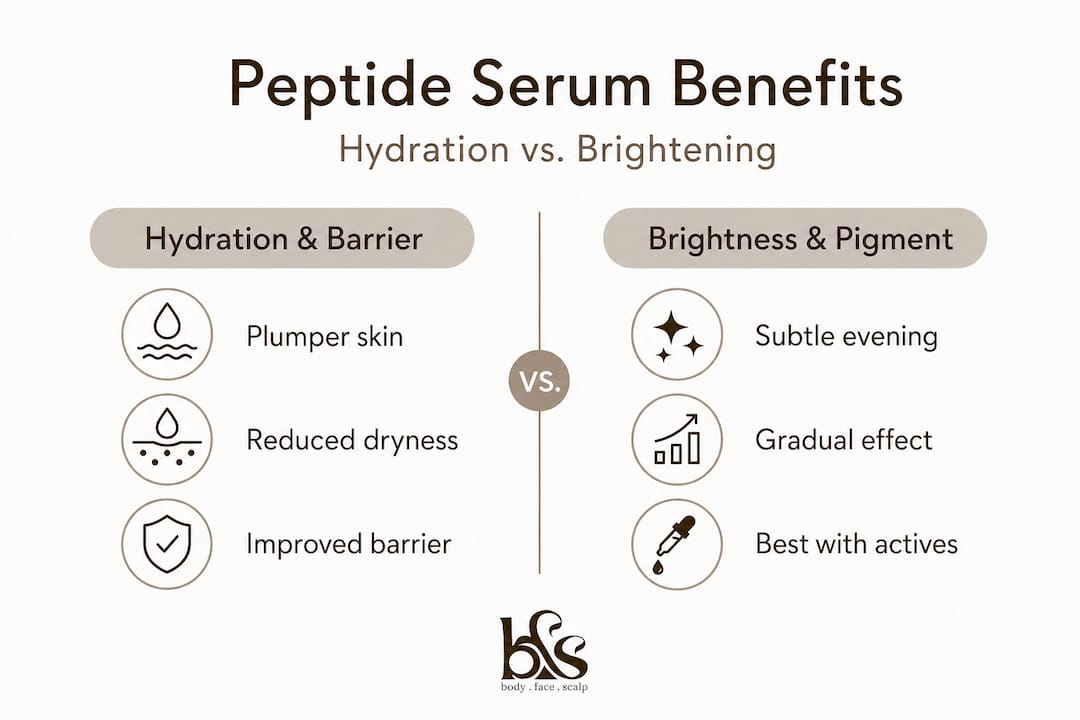
The evidence for hydration and barrier repair is the most consistent and compelling part of the peptide story. A clinical study of a biomimetic collagen tripeptide serum documented up to 93.7% reduction in facial dryness and a 72.5% hydration boost within four weeks, with no adverse events recorded. These are meaningful numbers, not statistical noise.
| Outcome measure | Evidence strength | Typical timeline |
|---|---|---|
| Hydration increase | Strong, well-replicated | Days to 4 weeks |
| Dryness reduction | Strong, well-replicated | 1 to 4 weeks |
| Skin barrier support | Moderate to strong | 4 to 8 weeks |
| Wrinkle reduction | Modest, variable | 8 to 12 weeks |
| Brightening/tone | Indirect, gradual | 6 to 12 weeks |
This table reflects the honest picture of what clinical evidence supports. Hydration is where peptides genuinely shine. For those of us living through Canadian winters with central heating and brutal cold, that kind of barrier-restoring power is no small thing. Understanding the depth of barrier-focused skincare science makes it clear why reinforcing your skin’s protective function is the foundation that everything else is built on.
Pro Tip: Applying your peptide serum immediately after cleansing, while your skin is still slightly damp, helps drive deeper absorption. Follow it with a barrier-restoring moisturiser to lock in both the serum and the hydration it supports. Layering matters.
Here is a simple routine structure that gets the most out of peptide serums for hydration and barrier repair:
- Cleanse gently using a low-pH, sulphate-free cleanser that doesn’t strip your barrier
- Apply your peptide serum to slightly damp skin, pressing rather than rubbing to avoid friction
- Wait 60 to 90 seconds to allow absorption before the next step
- Layer a ceramide-rich or barrier-focused moisturiser on top to seal in the serum’s benefits
- Apply SPF in the morning, every day, even in winter, since UV exposure undermines barrier repair faster than any serum can restore it
The right combination of ingredients for sensitive Canadian skin works alongside peptides to amplify barrier repair rather than competing with it. Think of peptides as the communication layer telling your skin what to do, and supporting ingredients as the raw materials helping it do the work.
Our Luster Booster Multi Peptide Serum is formulated with this layered approach in mind, combining multiple peptides with hydration-supporting actives in a water-based formula designed for Canadian skin conditions.
Peptides and hyperpigmentation: What the evidence really says
If hydration is the strongest suit for peptides, what about brightening and evening skin tone — so often highlighted on product labels?
Here is where we need to be honest with you. Peptides do have a role in the pigmentation conversation, but it is not the starring role. Research confirms that peptides act as modulators upstream in the pigment pathway rather than directly suppressing melanin production. They can influence how melanin is produced and transferred to skin cells, but they are not doing what niacinamide, tranexamic acid, or vitamin C do.
| Ingredient | Mechanism | Pigment reduction strength | Tolerability |
|---|---|---|---|
| Peptides | Upstream signalling modulation | Indirect, gradual | High |
| Niacinamide | Inhibits melanosome transfer | Moderate, reliable | High |
| Vitamin C | Inhibits tyrosinase enzyme | Moderate to strong | Moderate |
| Tranexamic acid | Blocks UV-induced pigment signals | Strong | High |
| Hydroquinone | Direct melanin suppressor | Strong | Low (requires monitoring) |
This comparison makes clear that peptides alone should not be your primary tool if hyperpigmentation is your main concern. What they do offer is meaningful support. When included in a formula alongside niacinamide or vitamin C, peptides can enhance overall results by supporting a healthier, more resilient skin surface that responds better to brightening actives.
Key factors that determine whether a peptide serum has any meaningful effect on pigmentation include:
- Specific peptides used: Not all peptides address pigmentation. Look for those with documented melanin-modulating activity
- Concentration in the formula: Below certain thresholds, many peptides don’t reach the concentrations needed for measurable effect
- Skin barrier integrity: A compromised barrier reduces penetration of any active, including peptides
- Consistency of use: Indirect, upstream benefits take longer to accumulate and require consistent daily application over months
- Supporting actives: Peptides paired with targeted hyperpigmentation remedies produce better results than peptides alone
The realistic expectation is gradual, subtle brightening over six to twelve weeks of consistent use, particularly when peptide serums are part of a multi-ingredient routine. Set that expectation clearly and you’ll be far more satisfied with the outcome.
Peptides and sensitive skin: Tolerability, barriers, and best practices
Beyond efficacy, one of the biggest questions is: are peptide serums suitable for easily irritated, sensitive, or compromised skin?

The short answer is yes, with an important qualification. Peptides themselves have a low inherent irritation potential. They are not exfoliating acids, they are not retinoids, and they don’t disrupt the skin’s surface pH. However, the tolerability of the full formula depends on every ingredient in the bottle, not just the peptides. A serum can be 90% gentle and still cause irritation if it contains a fragrance component, a high concentration of alcohol, or a sensitising preservative.
For those of you navigating reactive or sensitised skin, here are the practices we recommend:
- Patch test every new product on your inner arm or behind your ear for 48 hours before applying to your face
- Simplify your routine first before adding a new serum; the fewer actives competing for absorption, the clearer your read on how your skin responds
- Check the full ingredient list, not just the front label claims
- Start with once-daily application in the evening, when your skin is in repair mode and you can monitor for redness or tightening overnight
- Pair with a gentle, barrier-supportive moisturiser to buffer any sensitivity and support recovery
Pro Tip: The word “gentle” on a label tells you almost nothing. A fragrance-free, alcohol-free formula with a short, recognisable ingredient list is a far more reliable indicator of genuine tolerability for sensitive skin. Read the list, not the claim.
Expert guidance on selection: Patch testing is non-negotiable for sensitive skin. Beyond that, the smartest approach is to select peptide serums with minimal added fragrances and a formula that includes barrier-supporting ingredients such as ceramides or panthenol. These additions buffer the skin rather than demanding more from it.
Finding the right match for reactive skin is entirely possible. Our sensitive skin solutions resource walks through the specific ingredients and routines that work best for Canadian women managing sensitivity, including how to introduce new actives without triggering a reaction.
Why expecting miracles from peptides misses the real value
There is a version of the peptide serum conversation happening in marketing that we think does a disservice to people genuinely trying to improve their skin health. The language of “transformative,” “dramatic,” and “clinically proven” gets applied loosely to ingredients that are genuinely valuable but operate on a quieter, steadier timescale.
Here is what we actually know from the best available evidence: the most robustly supported benefits of peptide serums are hydration and barrier repair. Wrinkle reduction is possible but modest. Brightening is gradual and indirect. These are not failure states. They are honest outcomes.
The real value of peptides is what they contribute over months and years of consistent use: a skin surface that holds moisture better, responds to stress more resiliently, and maintains a more even tone as part of a thoughtful routine. That is worth having. It is just not the same as a clinical peel or a prescription retinoid.
What frustrates us is that when people expect miracles and don’t see them in two weeks, they abandon an ingredient that could have genuinely improved their skin over time. Peptides are not a quick fix. They are steady allies, working consistently in the background to keep your barrier functioning and your skin resilient through dry winters, indoor heat, and the environmental stressors that make Canadian skin particularly vulnerable.
The right mental model is this: peptides work best as part of a barrier-focused routine, not as a standalone hero. Pair them with effective barrier repair ingredients and stay consistent. That combination, over time, produces meaningful and lasting results.
Discover premium peptide skincare solutions
Ready to explore peptide serums and barrier-focused products designed for Canadian skin? Here’s where to start.
At Body Face Scalp™, we formulate with the evidence in mind. Every product in our line is built around barrier health, using ingredients at effective concentrations with formulations designed for the realities of Canadian climate and skin concerns. Whether you’re addressing dryness, working on skin tone, or building a more resilient foundation for your skin, our solutions are designed to work together as a system.
Explore our full premium skin care range to find the right combination for your routine. If you are starting with barrier repair, our barrier restoring moisturizer is an excellent pairing with any peptide serum, designed to lock in the benefits and give your skin the structural support it needs to thrive through every season.
Frequently asked questions
Can I use a peptide serum every day on sensitive skin?
Yes, most peptide serums are formulated for daily use even on sensitive skin, but always patch test first and review the full ingredient list for known irritants. As research confirms, it is the other ingredients in the formula, not the peptides themselves, that typically determine irritancy risk.
How soon should I expect to see results from a peptide serum?
Hydration and smoothness may improve within the first few days, while brightness and texture benefits generally appear after two to four weeks of consistent use. Clinical evidence documents up to 93.7% dryness reduction within the first four weeks, making hydration the earliest and most reliable outcome to watch for.
Are peptide serums safe to use with vitamin C or acids?
Yes, peptides are generally compatible with vitamin C and gentle exfoliating acids, but layering too many active ingredients at once can challenge even tolerant skin. Start slowly, introduce one new product at a time, and let your skin guide the pace. Formula composition and layering affect sensitivity far more than peptides alone.
Will peptide serums fade hyperpigmentation like a professional treatment?
Peptide serums can gradually contribute to a brighter, more even-toned complexion, but their direct impact on pigmentation is considerably less pronounced than professional treatments or prescription options. Peptides act through upstream modulation, not direct melanin suppression, so realistic expectations and a well-rounded brightening routine produce the best outcomes.
Recommended
- Luster Booster - Multi Peptide Serum (Water Based) – Body Face Scalp
- 5 most effective barrier repair ingredients for healthy skin – Body Face Scalp
- Sensitive skin solutions: Top expert-backed options for Canadians – Body Face Scalp
- Barrier-focused skincare: The science of resilient skin – Body Face Scalp