


Skin repair: 5 key ingredients for sensitive Canadian skin
TL;DR:
- Effective barrier repair requires specific ingredients like ultra-long chain ceramides, niacinamide, and humectants.
- Canadian climate demands formulations with optimal lipids, humectants, and minimal irritants for sensitive skin.
- Ingredient synergy, including ceramides, cholesterol, and fatty acids, is crucial for lasting skin barrier health.
Not all moisturisers are created equal, and if you have sensitive skin, that distinction matters enormously. Many products claim to repair your skin barrier, but only ingredient-specific formulas actually deliver measurable results. Canada’s climate adds another layer of complexity: cold winters, low humidity, and indoor heating strip moisture from your skin faster than most generic creams can replace it. We put together this evidence-based guide to walk you through exactly which ingredients repair sensitive skin, why they work, and how to use them together for real, lasting results.
Table of Contents
- Understanding the science of skin barrier repair
- Ceramides: The backbone of barrier repair
- Niacinamide, hyaluronic acid, and humectants: Boosters for sensitive skin repair
- Lipids, occlusives, and excipients: Completing the repair puzzle
- Why ingredient synergy matters more than any single superstar
- Premium ingredient-led skincare solutions for your sensitive skin
- Frequently asked questions
Key Takeaways
| Point | Details |
|---|---|
| Ingredient synergy | Combining ceramides, niacinamide, humectants, and lipids delivers the most effective barrier repair. |
| Ceramide ratios | The 3:1:1 ceramide:cholesterol:fatty acid ratio is optimal for sensitive skin recovery. |
| Canadian climate demands | Dry, harsh weather requires fragrance-free, multi-ingredient solutions for lasting results. |
| Avoid harsh excipients | Choose gentle, non-comedogenic formulas that skip harsh emulsifiers to prevent further sensitivity. |
| Layer hydration and repair | Pair humectants like hyaluronic acid with lipids for deeper hydration and enhanced repair. |
Understanding the science of skin barrier repair
Your skin barrier, known clinically as the stratum corneum, is the outermost layer of your skin. Think of it as a brick wall: your skin cells are the bricks, and a mixture of lipids (fats) holds them together like mortar. When that mortar breaks down, moisture escapes and irritants get in. The result is a compromised barrier that shows up as redness, flaking, tightness, and heightened sensitivity.
For Canadians, this breakdown happens more readily. Harsh winters drop humidity levels dramatically, and the shift between cold outdoor air and dry indoor heating creates a cycle of moisture loss that is hard to interrupt without the right ingredients. Sensitive skin is especially vulnerable because its barrier is already thinner and less resilient.
Signs your barrier needs repair include:
- Persistent dryness or flaking that doesn’t respond to basic moisturiser
- Stinging or burning when you apply skincare products
- Redness or blotchiness that worsens in cold weather
- Skin that feels tight shortly after cleansing
- Increased reactivity to products you previously tolerated
Repairing the barrier requires three things working together: replenishing the lipid matrix, restoring hydration within the skin cells, and calming inflammation. This is why ingredient selection is so critical. Research confirms that ultra-long chain ceramides (C24 to C30) show superior barrier recovery compared to shorter chain versions, meaning the specific type of ceramide in your product matters, not just whether ceramides appear on the label.
Your skin barrier is the foundation of healthy skin. Without it functioning properly, even the most nourishing actives cannot do their job effectively.
Understanding these repair mechanisms helps you read labels with confidence and choose effective barrier repair ingredients that actually match your skin’s needs.
Ceramides: The backbone of barrier repair
Ceramides are lipids that naturally occur in your skin and make up roughly 50% of the stratum corneum’s lipid content. They are the single most important structural component of a healthy barrier. When ceramide levels drop, due to ageing, harsh weather, or inflammatory skin conditions, the barrier weakens significantly.
Not all ceramides are the same. There are multiple subclasses, and the ones most relevant to barrier repair are ceramide NP, AP, and EOP. Each plays a distinct role in holding the lipid matrix together. Optimal topical ceramide formulas include these subclasses in a 3:1:1 ratio with cholesterol and fatty acids such as linoleic acid. This mimics the skin’s own natural lipid composition.
| Ceramide subclass | Key function | Found in healthy skin? |
|---|---|---|
| Ceramide NP | Structural integrity | Yes |
| Ceramide AP | Moisture retention | Yes |
| Ceramide EOP | Lipid matrix binding | Yes |
| Short-chain ceramides | Limited barrier effect | Partial |
The clinical evidence is compelling. Ceramide moisturisers reduce SCORAD (a measure of eczema severity) by 61% in atopic dermatitis and PASI scores by 65% in psoriasis, while also improving quality of life. They outperform basic emollients in barrier reinforcement, which explains why ceramide-focused formulas are a clinical standard for sensitive and reactive skin.
What makes a ceramide formula genuinely effective:
- Contains NP, AP, and EOP subclasses (check the full ingredient list)
- Includes cholesterol and fatty acids in the correct ratio
- Features ultra-long chain ceramides (C24 to C30) for superior recovery
- Is paired with emollient-based repair solutions for added lipid support
Pro Tip: Flip your product over and scan the ingredient list for “ceramide NP,” “ceramide AP,” and “ceramide EOP” specifically. If you only see “ceramide” without a subclass designation, the formula may not deliver the targeted repair you need. Explore best barrier repair ingredients to compare what to look for, and consider holistic barrier repair strategies that go beyond a single product.
Niacinamide, hyaluronic acid, and humectants: Boosters for sensitive skin repair
Ceramides may anchor repair, but these boosters are essential for optimal results, especially for sensitive skin. Niacinamide, hyaluronic acid, glycerin, and panthenol each address a different aspect of skin repair, and together they create a more complete solution.

Niacinamide (vitamin B3) is one of the most well-researched ingredients in skincare. At concentrations of 2 to 5%, it stimulates ceramide production by 34 to 67%, upregulates structural proteins like filaggrin and involucrin, reduces transepidermal water loss (TEWL) by 24%, and increases stratum corneum hydration by 35%. In plain terms: it helps your skin make more of its own ceramides while simultaneously locking in moisture.
Hyaluronic acid works differently. It is a humectant, meaning it draws water from the environment and deeper skin layers into the stratum corneum. Multi-molecular weight formulas are most effective because smaller molecules penetrate deeper while larger ones hydrate the surface. Hyaluronic acid and glycerin plump skin cells and must be paired with lipids or occlusives to prevent that water from evaporating right back out.
Here is how these boosters work together:
- Niacinamide boosts your skin’s own ceramide synthesis from within
- Hyaluronic acid draws water into the skin cells for immediate plumping
- Glycerin reinforces humectancy and supports the skin’s natural moisture factor
- Panthenol (provitamin B5) calms inflammation and supports cell renewal
- All four work best when layered over or combined with ceramide-rich formulas
Pro Tip: If you live in a low-humidity environment (which describes most of Canada in winter), apply your hyaluronic acid serum to slightly damp skin, then seal it with a ceramide moisturiser immediately. This prevents humectants from pulling moisture out of your skin rather than into it.
For expert-backed sensitive skin solutions and a deeper look at how these ingredients interact, our guide to barrier restoring moisturiser covers the full picture.
Lipids, occlusives, and excipients: Completing the repair puzzle
To make barrier repair stick, lipids and occlusives are essential, but formulary details can make or break success. Occlusives form a physical seal over the skin’s surface to slow water loss. Petrolatum is the gold standard: it reduces TEWL by up to 98%. However, occlusion alone is not enough. Without lipids underneath to replenish the barrier structure, you are simply trapping existing moisture rather than rebuilding the barrier itself.
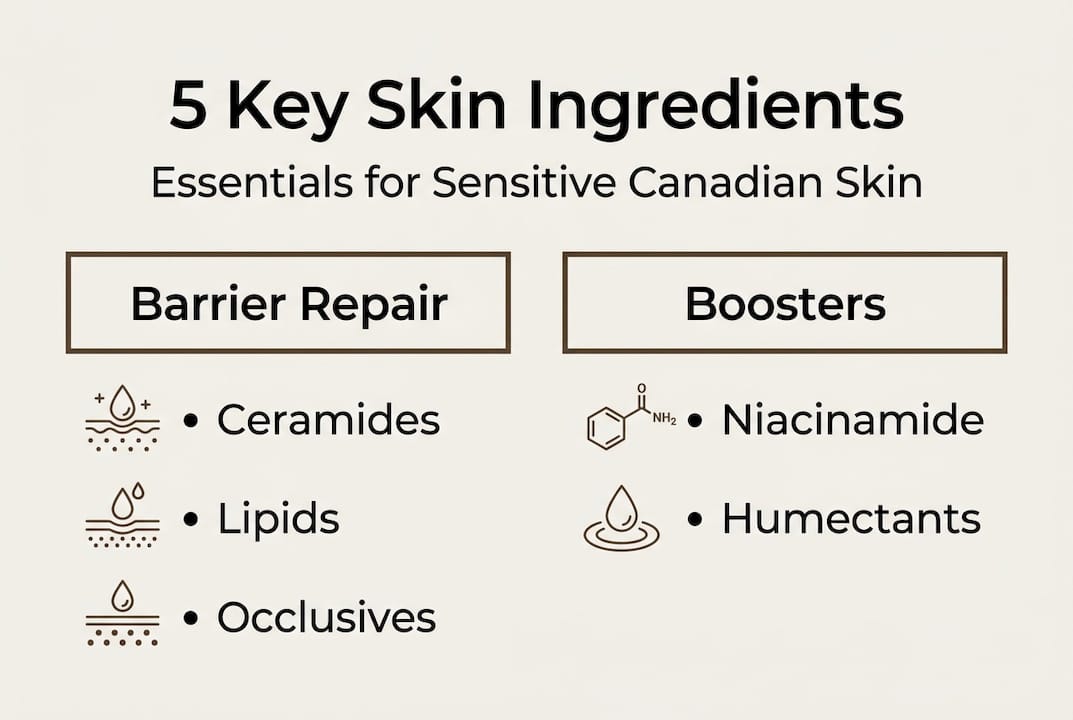
The most effective repair formulas combine occlusives with ceramides, fatty acids, and cholesterol to address both structure and sealing. This is the difference between a product that temporarily relieves dryness and one that actually repairs the barrier over time.
For sensitive skin, the excipients (inactive ingredients like preservatives, emulsifiers, and fragrances) matter just as much as the actives. Common pitfalls include:
- Fragrance and parfum: Even natural fragrances can trigger inflammation in sensitive skin
- Sodium lauryl sulphate (SLS): A surfactant that disrupts the lipid matrix
- Alcohol denat: Evaporates quickly and strips lipids from the skin
- Certain preservatives: Methylisothiazolinone is a known sensitiser
For sensitive skin in Canada’s dry climate, dermatologists recommend fragrance-free formulas that combine ceramides, niacinamide, and hyaluronic acid for comprehensive barrier support.
Our moisture barrier guide explains how to identify these problematic ingredients on a label. For a broader look at what triggers sensitivity and how to address it, see our resource on causes of sensitivity and repair strategies. And if you adjust your routine with the seasons, our seasonal skincare tips offer practical guidance for every time of year.
Why ingredient synergy matters more than any single superstar
Beyond the science and product recommendations, a fresh perspective can help you avoid common mistakes and elevate your results. The skincare industry loves a hero ingredient. Ceramides had their moment. Then retinol. Then niacinamide. The problem with this single-ingredient focus is that your skin barrier is a system, not a single component.
We have seen this play out repeatedly: someone switches to a ceramide-only cream and sees modest improvement, then adds niacinamide and notices a real shift, then refines their routine with a proper occlusive and finally feels like their skin is healing. That progression is not coincidence. Synergistic use of lipids, humectants, and niacinamide is optimal for barrier repair in sensitive skin precisely because single ingredients cannot address every repair mechanism simultaneously.
Canada’s climate makes this even more relevant. Cold, dry air accelerates TEWL. Indoor heating dehydrates the stratum corneum. A ceramide alone cannot compensate for those conditions. You need the lipid trio (ceramides, cholesterol, fatty acids), a humectant to draw in water, and an anti-inflammatory like niacinamide working together. Research into ceramide synthesis pathways confirms that bioactives like niacinamide enhance the skin’s own production mechanisms, meaning the right combination actively teaches your skin to repair itself more efficiently.
Layering is not just a routine preference. It is a repair strategy. Start with your humectant, follow with your ceramide moisturiser, and seal with an occlusive if needed. Explore holistic barrier repair philosophy to see how this approach translates into a full routine.
Premium ingredient-led skincare solutions for your sensitive skin
Now that you know exactly what to look for, finding the right products becomes much more straightforward. At Body Face Scalp™, we formulate with ingredient synergy at the centre of everything we do, because we know that sensitive Canadian skin needs more than a single standout ingredient.

Our barrier restoring moisturiser brings together ceramides, niacinamide, and hyaluronic acid in a fragrance-free formula designed specifically for sensitive skin in Canada’s climate. Browse our full skincare collection to explore ingredient-led options for every concern, from dryness and hyperpigmentation to reactive and post-procedure skin. Our complete range of skin care solutions is built on the same evidence-based philosophy: the right ingredients, in the right ratios, working together.
Frequently asked questions
What are the most important ingredients for repairing sensitive skin barriers?
Ceramides (NP, AP, EOP), niacinamide, hyaluronic acid, glycerin, and panthenol are clinically proven for barrier repair, and synergistic use of all these outperforms any single ingredient on its own.
Why don’t all moisturisers work for sensitive skin in Canada?
Canada’s dry climate demands formulas with optimal ceramide ratios, humectants, and occlusive support. Dermatologists recommend fragrance-free ceramide, niacinamide, and hyaluronic acid formulas because basic emollients or harsh excipients can worsen sensitivity rather than resolve it.
How does niacinamide improve skin barrier function?
Niacinamide stimulates ceramide production, reduces transepidermal water loss, and increases stratum corneum hydration, making it one of the most effective barrier-supporting actives available for sensitive skin.
What is the ideal ceramide ratio for effective barrier repair?
A 3:1:1 ratio of ceramides, cholesterol, and fatty acids mimics the skin’s own lipid composition and delivers the most effective barrier recovery results in clinical studies.
Recommended
- 5 most effective barrier repair ingredients for healthy skin – Body Face Scalp
- Sensitive skin solutions: Top expert-backed options for Canadians – Body Face Scalp
- What causes skin sensitivity and how to repair your barrier – Body Face Scalp
- Why seasonal skincare matters for sensitive skin in Canada – Body Face Scalp