


What causes skin sensitivity and how to repair your barrier
TL;DR:
- Nearly half of Canadian women experience skin sensitivity caused by biological factors and underlying conditions.
- Hormonal fluctuations, stress, and barrier dysfunction significantly influence skin reactivity and chronic conditions like eczema and rosacea.
- Holistic barrier repair with targeted ingredients and consistent skincare improves resilience and long-term skin health.
Nearly half of Canadian women live with skin sensitivity, yet most assume it’s simply a matter of finding the right cleanser or avoiding fragrance. The reality is far more layered. 44.3% of Canadian women between the ages of 18 and 55 report sensitive skin, and the underlying causes range from hormonal fluctuations to barrier dysfunction to chronic skin conditions. This article breaks down the biological triggers driving sensitivity, explains what’s actually happening at the skin barrier level, and outlines evidence-based strategies to build lasting resilience. If your skin reacts easily and you’re tired of guessing, this is where clarity begins.
Table of Contents
- The prevalence and complexity of skin sensitivity in Canadian women
- Biological factors: Hormonal fluctuations, stress and the skin barrier
- Underlying skin conditions and their link to sensitivity
- Barrier repair: Building resilience against skin sensitivity
- Why holistic, ingredient-led repair works better than quick fixes
- Ingredient-conscious skincare for resilient skin: Next steps
- Frequently asked questions
Key Takeaways
| Point | Details |
|---|---|
| Hormonal shifts increase risk | Changes in estrogen and progesterone significantly raise the likelihood of skin sensitivity for Canadian women. |
| Barrier dysfunction is central | Most sensitive skin stems from weakened skin barriers, often aggravated by chronic conditions and environmental stress. |
| Repair requires evidence-based ingredients | Lipids and natural moisturising factors in optimal ratios drive lasting resilience and reduce sensitivity rates. |
| Holistic approach beats quick fixes | Combining biological knowledge and ingredient-conscious choices delivers sustained improvement compared to temporary solutions. |
The prevalence and complexity of skin sensitivity in Canadian women
Skin sensitivity is not a personality trait or a sign of weakness. It is a measurable, physiological response that affects a significant portion of Canadian women across all age groups. Understanding just how common it is, and why it varies, helps remove the guesswork from finding solutions.
Research confirms that sensitivity affects 44.3% of Canadian women aged 18 to 55, with rates climbing higher among those with irregular menstrual cycles. This is not a minor subset. It means nearly one in two women you know may be navigating reactive, uncomfortable skin on a regular basis.
What makes sensitivity complex is that it does not have a single cause. Experts view it through two lenses:
- Subjective syndrome: Sensitivity is experienced as stinging, burning, or itching without a visible cause
- Barrier defect: The skin’s outer protective layer is compromised, allowing irritants and allergens to penetrate more easily
In many cases, both are present simultaneously. That overlap is what makes sensitivity so persistent and so frustrating to manage without the right information.
| Factor | Lower sensitivity risk | Higher sensitivity risk |
|---|---|---|
| Menstrual cycle | Regular cycles | Irregular cycles |
| Age | 18 to 30 | 31 to 55 |
| Skin type | Oily | Dry or combination |
| Climate exposure | Mild, humid | Cold, dry (e.g., Canadian winters) |
Common triggers reported by sensitive-skinned women include:
- Harsh cleansers and surfactants
- Extreme temperature changes
- Synthetic fragrances and preservatives
- Stress and hormonal shifts
- Environmental pollution
“Sensitive skin is not simply a cosmetic concern. It reflects real biological variability in how the skin perceives and responds to its environment.”
For a broader overview of what works, expert-backed sensitive skin solutions offer a strong starting point for Canadian women navigating these challenges.
Biological factors: Hormonal fluctuations, stress and the skin barrier
With context on prevalence, we can now explore the specific biological mechanisms that drive sensitivity. The skin barrier is not static. It shifts with your hormones, your stress levels, and even the health of your skin’s microbiome.
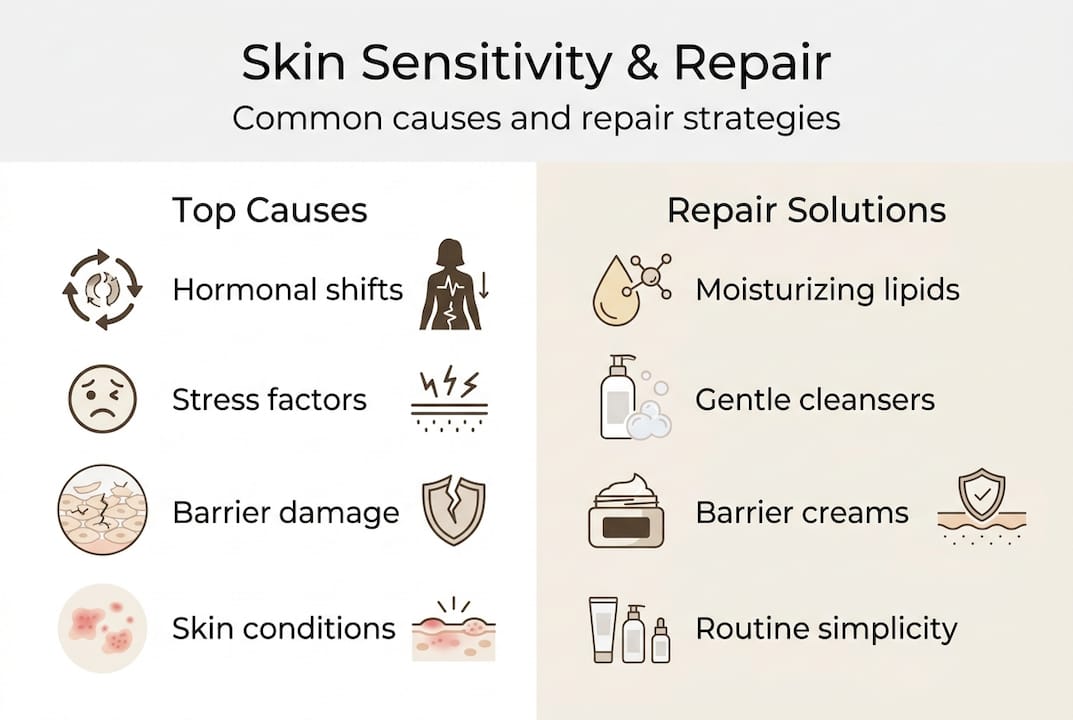
Hormonal changes are among the most significant drivers. Fluctuations in estrogen and progesterone during adolescence, pregnancy, and menopause all alter how the skin barrier functions. Estrogen supports ceramide production (the lipids that hold your barrier together), so when levels drop, barrier integrity weakens. The result is skin that loses moisture faster and reacts more easily to products and environmental stressors.

Women with irregular menstrual cycles are particularly affected. Hormonal fluctuations worsen sensitivity by lowering the skin’s tolerance threshold, meaning even mild stimuli can trigger a reaction. This is not imagined sensitivity. It is a physiological response tied directly to hormonal variability.
Psychological stress adds another layer. When you are under chronic stress, your body releases cortisol and activates neurogenic (nerve-driven) inflammation pathways in the skin. This lowers the barrier’s resilience and increases reactivity. Microbiome imbalance and oxidative stress further compound the problem by disrupting the skin’s natural defence mechanisms.
Here is how these biological factors interact:
- Hormonal shifts reduce ceramide and lipid production
- Reduced lipids increase transepidermal water loss (TEWL), meaning the skin loses moisture through evaporation
- Higher TEWL leaves the barrier porous and reactive
- Stress amplifies inflammation, making the skin even more sensitive to stimuli
- Microbiome disruption removes protective bacteria, further weakening the barrier
Pro Tip: If your skin flares predictably around your cycle or during high-stress periods, that is a signal to simplify your routine and focus on barrier support during those windows. A targeted routine for sensitive skin can help you adapt based on what your skin needs at different times of the month.
Understanding these mechanisms is foundational. You can learn more about the biology behind this in our guide to understanding the moisture barrier.
Underlying skin conditions and their link to sensitivity
Beyond triggers, many women experience sensitivity as a symptom of underlying skin conditions. Sensitivity is often not a standalone issue. It is the visible, felt expression of a deeper imbalance.
Three conditions are most commonly linked to chronic skin sensitivity in Canadian women:
- Atopic dermatitis (AD): A chronic inflammatory condition where the barrier is genetically compromised, allowing allergens and irritants to penetrate easily
- Eczema: Often used interchangeably with AD, eczema causes dry, itchy, inflamed patches and is closely tied to barrier dysfunction
- Rosacea: A vascular condition causing redness and flushing, often triggered by the same environmental and emotional stressors that worsen sensitivity
The numbers are significant. AD affects 17% of Canadians, and barrier dysfunction sits at the centre of all three conditions. When the barrier is compromised, the skin cannot regulate moisture, temperature, or immune responses effectively.
| Condition | Primary barrier issue | Common sensitivity triggers |
|---|---|---|
| Atopic dermatitis | Filaggrin deficiency | Allergens, cold air, detergents |
| Eczema | Lipid depletion | Fragrances, heat, stress |
| Rosacea | Vascular reactivity | UV exposure, spicy foods, alcohol |
“When the barrier is compromised, the skin is in a constant state of low-grade inflammation. Sensitivity is the symptom. The barrier is the cause.”
What makes these conditions particularly challenging is that they often go undiagnosed for years. Many women attribute their reactive skin to product sensitivity alone, cycling through cleansers and moisturisers without addressing the root issue. Recognising that a condition like AD or rosacea may be driving the reactivity is the first step toward meaningful improvement.
Learning about the types of skin barriers can help you identify where your own barrier may be most vulnerable and which conditions may be at play.
Barrier repair: Building resilience against skin sensitivity
Once we understand sensitivity’s roots, the next step is actionable repair strategies grounded in clinical results. The good news is that the skin barrier is remarkably responsive to the right ingredients, applied consistently.
Effective barrier repair centres on three categories of ingredients:
- Ceramides: Lipids that make up roughly 50% of the skin’s outer layer. They act like mortar between skin cells, preventing moisture loss and blocking irritants
- Cholesterol and fatty acids: Work alongside ceramides to maintain the correct lipid ratio. The optimal ratio is approximately 1:1:1 (ceramides to cholesterol to fatty acids)
- Natural moisturising factors (NMF): Water-binding molecules including hyaluronic acid, amino acids, and urea that keep the skin hydrated from within
Clinical evidence supports this approach strongly. A four-week study found that NMF and lipid-based moisturisers delivered +157% hyaluronic acid increase, a 30% increase in skin lipids, and a 77% increase in filaggrin (a key structural protein), all while reducing TEWL significantly.
These are not marginal improvements. They represent a measurable restoration of barrier function in clinically sensitive skin.
Pro Tip: Look for moisturisers that list ceramides, cholesterol, and fatty acids together. A product with only one of these ingredients will not deliver the same repair benefit as one formulated with all three in a balanced ratio.
Key practices to support barrier repair:
- Cleanse with low-pH, surfactant-free or gentle formulas
- Apply moisturiser to slightly damp skin to lock in hydration
- Avoid over-exfoliating, which strips the barrier further
- Use SPF daily to protect against UV-induced barrier damage
For deeper reading on what to look for, explore effective barrier repair ingredients and the role of emollient-based barrier repair in long-term skin health. Our barrier restoring moisturiser guide also walks through how to choose the right product for your skin type, and holistic barrier repair explains how to bring all these strategies together.
Why holistic, ingredient-led repair works better than quick fixes
Here is what most brands get wrong: they treat sensitivity as a problem to suppress rather than a signal to understand. Anti-redness serums and soothing mists can offer temporary relief, but they do not address why the skin is reacting in the first place.
We believe that sensitivity is both a syndrome and a barrier defect, which means true resolution requires addressing both the subjective experience and the structural cause. That takes time, the right ingredients, and a consistent approach.
Quick fixes often contain actives that calm inflammation briefly while simultaneously disrupting the microbiome or stripping lipids. The cycle repeats. Holistic repair, by contrast, works with the skin’s biology. It replenishes what is depleted, strengthens what is weakened, and builds resilience over weeks rather than masking reactivity for hours.
At Body Face Scalp™, we see this approach deliver lasting results for Canadian women navigating harsh climates, hormonal shifts, and chronic skin conditions. Explore what holistic repair for Canadian skin looks like in practice, and why it consistently outperforms the quick-fix model.
Ingredient-conscious skincare for resilient skin: Next steps
If this article has helped you see your skin sensitivity in a new light, the next step is finding products that match the science. At Body Face Scalp™, every formulation is built around barrier repair, ingredient transparency, and real results for Canadian skin.

Our premier skincare collection is designed for women who want more than temporary relief. Each product is formulated with clinically relevant ingredients at effective concentrations. Start with our barrier restoring moisturiser, built on the ceramide, cholesterol, and fatty acid ratios discussed in this article. As a Canadian barrier repair brand, we are here to support your skin through every season, every hormonal shift, and every step of the repair process.
Frequently asked questions
Is sensitive skin always linked to a damaged barrier?
Skin sensitivity often stems from barrier dysfunction, but neurogenic inflammation and individual genetic factors can also play a significant role, sometimes independently of barrier integrity.
How do hormonal changes affect skin sensitivity?
Fluctuations in estrogen and progesterone, especially during pregnancy or menopause, impair barrier function by reducing ceramide production and lowering the skin’s tolerance threshold.
What is TEWL and why is reducing it important?
TEWL stands for transepidermal water loss, the rate at which moisture evaporates through the skin. Reducing TEWL protects hydration levels and signals a stronger, more intact barrier.
Are ingredient-led moisturisers really better for sensitive skin?
Moisturisers formulated with clinically proven ratios of ceramides, cholesterol, and fatty acids consistently outperform generic formulas in both barrier repair outcomes and long-term sensitivity reduction.
Recommended
- Understand your skin barrier: how to protect and repair it – Body Face Scalp
- What is a moisture barrier? Your guide to healthy skin – Body Face Scalp
- The Ultimate Guide to Barrier Restoring Moisturizer: What It Is, Why Y – Body Face Scalp
- Emollients for barrier repair: ingredient-led solutions that work – Body Face Scalp