


Skincare ingredients to avoid in summer: 2026 guide
TL;DR:
- During summer, avoid photosensitizing actives, heavy occlusives, and citrus oils to prevent irritation and hyperpigmentation. Instead, reduce exfoliant and retinoid frequency, switch to lightweight, non-comedogenic moisturizers, and consistently apply mineral sunscreen every 2-3 hours. Focus on barrier support with gentle ingredients like niacinamide, ceramides, and aloe vera while maintaining a simple skincare routine.
Photosensitising actives, heavy occlusives, and certain essential oils are the skincare ingredients to avoid in summer if you want to prevent irritation, breakouts, and hyperpigmentation. When temperatures rise and UV exposure peaks, ingredients that are perfectly safe in winter can turn problematic. They strip your barrier, clog pores under sweat, or trigger phototoxic reactions that leave lasting pigment damage. Knowing which ingredients to skip in summer, and how to adjust rather than abandon your routine, is the difference between glowing skin and a frustrating setback.
What skincare ingredients to avoid in summer: exfoliants and retinoids
Strong chemical exfoliants and retinoids top the list of summer skin irritants. They work by accelerating cell turnover, which sounds like a benefit until you factor in UV exposure.
Here is what to watch for:
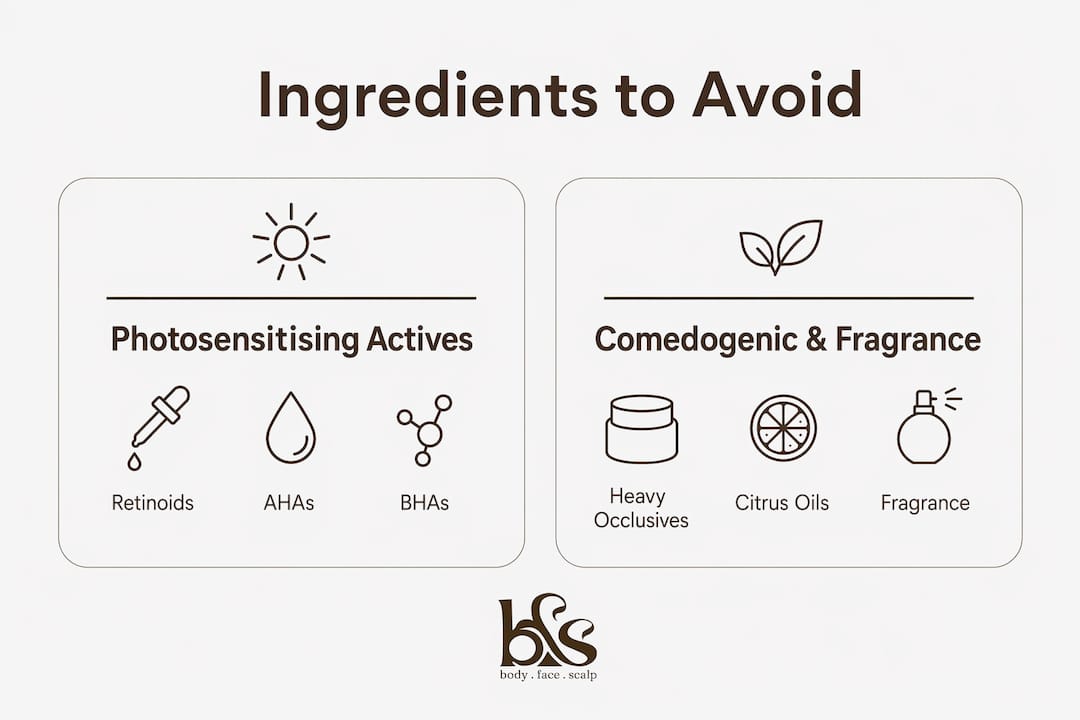
- AHAs (alpha hydroxy acids): Glycolic acid, lactic acid, and mandelic acid dissolve the bonds between dead skin cells. That freshly exposed skin is significantly more vulnerable to UV damage.
- BHAs (beta hydroxy acids): Salicylic acid penetrates pores and reduces oil, but it also increases UV sensitivity by up to 100%, raising your risk of irritation and hyperpigmentation.
- Retinoids: Retinol, tretinoin, and adapalene all thin the outermost skin layer temporarily. Use them at night only, and pair them with a high-SPF mineral sunscreen every single morning.
- Physical scrubs: Mechanical exfoliants cause microtears in the skin surface. In summer, those microtears become entry points for UV damage and bacteria. Skip them entirely.
The goal is not to stop using these ingredients completely. Retinoids and acids can still be used safely in summer by reducing application frequency and spacing treatments to avoid cumulative irritation. If you normally use glycolic acid three times a week, drop to once a week in july and august. If you use retinol nightly, shift to every second or third night.
Gentler alternatives worth considering include bakuchiol, a plant-derived retinol alternative that does not carry the same photosensitivity risk. Polyhydroxy acids (PHAs) like gluconolactone also exfoliate more gently than glycolic acid and are a strong swap for sensitive skin in summer.
Pro Tip: If you use a retinoid or AHA at night, apply your broadspectrum mineral sunscreen the following morning without fail. UV rays penetrate glass and clouds, so sunscreen is essential even indoors, with reapplication every 2–3 hours for full protection.
Are comedogenic oils and heavy occlusives harmful in summer?
Comedogenicity refers to an ingredient’s tendency to clog pores. Every ingredient is rated on a scale of 0 to 5, where 0 means no pore-clogging risk and 5 means very high risk. In cool, dry conditions, a rating of 3 or 4 may be tolerable. In summer heat and humidity, ingredients scoring 3 or higher become a real problem for acne-prone and oily skin types.
| Ingredient | Comedogenic rating | Better summer alternative |
|---|---|---|
| Coconut oil | 4 | Squalane (rating: 1) |
| Lanolin | 4 | Glycerin (rating: 0) |
| Beeswax | 2–3 | Aloe vera gel |
| Mineral oil | 0–2 (varies) | Hyaluronic acid serum |
| Cocoa butter | 4 | Rosehip oil (rating: 1) |
Heat and sweat compound the problem. Sweat mixes with heavy occlusive ingredients sitting on the skin surface, creating a film that traps debris and bacteria inside pores. Even oily skin can become dehydrated in summer heat, which triggers more oil production and more breakouts. Choosing gel-based, non-comedogenic moisturisers with humectants like hyaluronic acid keeps skin hydrated without the occlusive weight.
For a full breakdown of which pore-clogging ingredients are most problematic in humid conditions, the non-comedogenic ingredients list from Bodyfacescalp is a practical reference, particularly for oily and acne-prone skin types.
Pro Tip: Switch your daytime moisturiser to a water-based or gel formula in summer. Save richer creams and occlusive balms for your nighttime routine when your skin is not exposed to heat and sweat.
Why do fragrance and citrus oils cause summer skin reactions?
Fragrance is one of the most common summer skin irritants, and citrus-based essential oils are the most problematic category. Bergamot, lemon, and lime oils contain furanocoumarins, compounds that become reactive when exposed to UV light. This reaction is called phototoxicity. The result is redness, burning, and in many cases, hyperpigmentation from phototoxic reactions that can take months to fade.
Ingredients to avoid in summer skincare products include:
- Bergamot oil: Found in many perfumes and some toners. Highly phototoxic.
- Lemon and lime essential oils: Common in brightening serums and natural deodorants.
- Synthetic fragrance (listed as “parfum”): Can trigger allergic contact dermatitis, which worsens with UV exposure and heat.
- Oxybenzone: A chemical UV filter that absorbs into the skin and has a higher irritation profile than mineral alternatives. Zinc oxide and titanium dioxide are the preferred options for sensitive skin in summer.
Soothing, fragrance-free ingredients are your best allies during warmer months. Aloe vera calms inflammation and provides light hydration. Niacinamide (vitamin B3) strengthens the skin barrier, reduces redness, and helps manage post-inflammatory hyperpigmentation. Neither ingredient increases photosensitivity, making them ideal for daily summer use.
If you are unsure whether your current products contain hidden fragrance or phototoxic compounds, reviewing the skincare ingredients to avoid guide from Bodyfacescalp is a useful starting point.
How to adjust your summer skincare routine
The best summer skincare practices are built on simplicity. Simplicity in summer skincare reduces the risk of ingredient incompatibility and cumulative inflammation, both of which are harder to manage when your skin is already stressed by heat and UV exposure.
Follow these steps to build a smarter summer routine:
- Reduce active frequency, not actives entirely. Drop your retinoid or AHA to once or twice a week instead of daily. Your skin still benefits without the compounded sensitivity.
- Simplify your layering. Fewer products mean fewer chances for irritation. A gentle cleanser, a lightweight hydrating serum, a non-comedogenic moisturiser, and a mineral SPF covers most skin types well.
- Prioritise barrier-supporting ingredients. Ceramides restore the lipid layer that heat and UV exposure deplete. Niacinamide reduces inflammation and regulates oil. Panthenol (provitamin B5) soothes and retains moisture without clogging pores.
- Use hyaluronic acid strategically. Hyaluronic acid draws moisture from the environment into the skin. In humid summer conditions, it works exceptionally well. Apply it to damp skin and seal with a lightweight moisturiser.
- Apply broad-spectrum mineral sunscreen every morning. SPF 30 is the minimum; SPF 50 is better if you are spending time outdoors. Tanning is a biological response to DNA damage, and every unprotected exposure adds to long-term ageing and pigment risk.
- Reapply sunscreen every 2–3 hours. One morning application is not enough. Sweat, water, and time all reduce SPF efficacy.
A barrier-focused face care workflow is especially useful here. Minimal layering and careful ingredient selection reduce summer skin irritation and preserve barrier function when your skin needs it most.
Pro Tip: Keep a facial mist with niacinamide or aloe vera in your bag for midday refreshing. It rehydrates without adding product weight and helps your sunscreen reapplication go on more smoothly.
Key takeaways
Avoiding photosensitising actives, comedogenic occlusives, and fragrance in summer, while maintaining consistent mineral SPF use, is the most reliable way to protect your skin barrier through warmer months.
| Point | Details |
|---|---|
| Reduce exfoliant frequency | Cut AHAs and retinoids to once or twice a week to lower UV sensitivity and irritation risk. |
| Swap heavy occlusives | Replace coconut oil, lanolin, and beeswax with squalane, rosehip oil, or gel moisturisers in summer. |
| Avoid fragrance and citrus oils | Bergamot, lemon, and lime oils cause phototoxic reactions; choose fragrance-free formulas instead. |
| Support your barrier daily | Use ceramides, niacinamide, and panthenol to keep skin resilient against heat and UV stress. |
| Reapply sunscreen consistently | Broad-spectrum mineral SPF must be reapplied every 2–3 hours, even on cloudy or indoor days. |
Summer skincare is about adjustment, not abandonment
I have seen a lot of people make the same mistake every june: they read that retinoids and acids are “bad for summer” and throw out half their routine. Then they wonder why their skin feels dull and congested by august.
The truth is more nuanced. Your skin builds tolerance to actives over time. Stopping them completely and restarting in autumn is harder on your barrier than simply dialling back frequency. What I recommend is a seasonal recalibration, not a reset.
The clients and readers I have worked with who maintain the best summer skin share a few habits. They keep their routine short. They never skip SPF, even on overcast Canadian days when UV levels are still significant. And they pay attention to how their skin responds week to week rather than following a rigid schedule.
Hydration is the piece most people underestimate in summer. Heat dehydrates skin faster than cold air does, and dehydrated skin overproduces oil, which leads to the very breakouts people were trying to avoid. A lightweight hyaluronic acid serum and a non-comedogenic moisturiser are not optional steps. They are what keeps your barrier intact while your actives do their work at reduced frequency.
If your skin is showing signs of barrier damage from summer ingredients, the compromised skin barrier solutions guide from Bodyfacescalp covers ten practical methods to repair it. Start there before adding anything new back into your routine.
Sun protection remains the foundation that makes everything else possible. Without it, every active you use becomes a liability.
— Mohid
How Bodyfacescalp supports your summer skin
Summer calls for a different kind of skincare, and Bodyfacescalp formulates with exactly that in mind.
At Bodyfacescalp, we build products around barrier repair, lightweight hydration, and non-comedogenic ingredients that work with your skin rather than against it in the heat. Our summer skincare collection includes gentle cleansers, barrier-restoring moisturisers, and fragrance-free formulas designed to keep your skin calm and protected through peak UV months. For targeted barrier support, our Barrier Restoring Moisturizer delivers ceramides, niacinamide, and panthenol in a lightweight, non-comedogenic base that works year-round and is especially effective when your skin is under summer stress.
FAQ
Which ingredients increase sun sensitivity the most?
Retinoids, AHAs like glycolic and lactic acid, and BHAs like salicylic acid are the top photosensitising ingredients. They accelerate cell turnover and leave freshly exposed skin significantly more vulnerable to UV damage.
Can I still use retinol in summer?
Yes. Retinoids do not need to be stopped in summer but should be applied at night and paired with a high-SPF mineral sunscreen every morning. Reduce application frequency during peak UV months.
What are the best non-comedogenic ingredients for summer skincare?
Squalane, rosehip oil, hyaluronic acid, niacinamide, and aloe vera are all low-comedogenic and well-tolerated in summer. They hydrate and support the barrier without clogging pores under heat and sweat.
Why should I avoid fragrance in summer skincare?
Citrus-based essential oils like bergamot, lemon, and lime contain compounds that react with UV light, causing phototoxic reactions. Synthetic fragrance also increases the risk of allergic contact dermatitis, which worsens with heat and sun exposure.
How often should I reapply sunscreen in summer?
Reapply broad-spectrum sunscreen every 2–3 hours for effective protection. Sweat and time reduce SPF efficacy, and UV rays penetrate glass and cloud cover, making indoor reapplication necessary as well.