


Skincare routine for women aged 25–40
TL;DR:
- Skin in your mid-twenties begins to decline in collagen and cell turnover, requiring targeted skincare adjustments.
- Consistency with barrier support, daily SPF, and gradual introduction of actives yields the best long-term results.
Your skin in your mid-twenties is not the same skin you had at nineteen, and your early forties will ask even more of you. If you’ve been juggling dryness, hormonal breakouts, lingering acne scars, and a bathroom shelf crowded with products that don’t seem to work together, you’re not alone. Building a skincare routine for 25–40 women requires understanding what your skin is actually doing at each stage, then responding with the right products in the right order. This guide cuts through the noise and gives you a practical, science-backed plan.
Table of Contents
- Key takeaways
- How your skin changes between 25 and 40
- Your skincare ingredient toolkit
- Your morning and evening routine, step by step
- Troubleshooting common skincare mistakes
- Tracking progress and building habits that last
- My honest take on skincare in your twenties, thirties, and forties
- Build your routine with Bodyfacescalp
- FAQ
Key takeaways
| Point | Details |
|---|---|
| Skin changes are gradual but significant | Collagen loss and slower cell turnover begin in your mid-twenties and require targeted product adjustments. |
| Barrier support comes first | Moisturisers with ceramides and fatty acids form the foundation of every effective routine. |
| SPF is non-negotiable | Broad-spectrum SPF 30–50 applied daily is the single most powerful anti-ageing step you can take. |
| Introduce actives slowly | Starting retinoids at low concentration once or twice weekly prevents irritation and builds tolerance safely. |
| Consistency beats complexity | A simple routine used every day delivers better results than a complicated one used sporadically. |
How your skin changes between 25 and 40
Understanding what is happening beneath the surface makes every product decision easier. Your skin is not just ageing. It is shifting in ways that are measurable, predictable, and addressable.
After age 25, collagen production declines at roughly 1% per year, and cell turnover slows from the brisk 28-day cycle of your youth to a sluggish 35–45 days by your mid-thirties. That slowdown is why dullness, uneven texture, and acne scars take longer to fade. It is also why the brightening serum that worked in your twenties may feel underwhelming now.
By your thirties, hormonal fluctuations become more pronounced. Oestrogen levels begin a gradual decline, reducing the skin’s natural oil production and compromising the moisture barrier. You may notice your skin feeling tight in the morning, reacting to products it once tolerated, or breaking out in ways that feel confusingly adult. These are not random events. They reflect predictable biology.
Here is what you are most likely dealing with across this age range:
- Dryness and dehydration. Reduced sebum production and a weakening moisture barrier make it harder for skin to retain water.
- Sensitivity and reactivity. A compromised barrier lets irritants in more easily, causing redness, stinging, and flare-ups.
- Hyperpigmentation. Sun damage accumulates over time, and post-inflammatory marks from breakouts take longer to fade as cell turnover slows.
- Hormonal acne. Typically appearing along the chin and jawline, this type of breakout is driven by androgen activity and is common well into the forties.
- Early fine lines. Expression lines around the eyes and mouth become more visible as collagen thins and skin loses elasticity.
Recognising which of these concerns apply to you determines which actives belong in your routine and which ones you can skip entirely.
Your skincare ingredient toolkit
Knowing which ingredients to reach for, and which to avoid, is the practical foundation of any effective skincare for 25–40 women. You do not need an overwhelming product collection. You need the right ones.
Gentle cleanser. Your cleanser should remove dirt, SPF, and makeup without stripping the skin’s natural oils. Look for sulphate-free formulas labelled as “non-stripping” or “pH-balanced.” Foaming cleansers with sodium lauryl sulphate are a common culprit for sensitivity and barrier damage.

Barrier-supporting moisturiser. This is the cornerstone of the routine. Barrier-supporting formulas can improve skin moisture levels by 43% within three hours and 58% after three days of consistent use. Look for ceramides (which reinforce the skin’s protective layer), fatty acids (which replenish lipids), and hyaluronic acid (a humectant that draws water into the skin). For a deeper understanding of how these formulas work, Bodyfacescalp’s guide to barrier repair is a useful starting point.
Broad-spectrum SPF 30–50. Daily SPF use is the top anti-ageing and skin-protective measure recommended by dermatologists across the board. Apply it every morning, including overcast days and days spent mostly indoors near windows.
Retinoids. These vitamin A derivatives are the gold standard for collagen stimulation and accelerating cell turnover. They address fine lines, hyperpigmentation, and acne simultaneously. Prescription tretinoin is the most potent form; over-the-counter retinol is gentler and appropriate for most beginners.
Vitamin C. A potent antioxidant that brightens hyperpigmentation, stimulates collagen, and protects against free radical damage from UV exposure. Best used in the morning before SPF.
Niacinamide. A form of vitamin B3 that reduces redness, minimises the appearance of pores, and helps regulate oil production. It plays well with most other actives and is especially useful for those dealing with hormonal acne alongside sensitivity.
Peptides and hyaluronic acid serums. Hydrating serums with hyaluronic acid and peptides support skin hydration and signal collagen production. They work well layered under moisturiser in both morning and evening routines.
Pro Tip: Avoid products with synthetic fragrance if your skin is reactive. Fragrance is one of the most common contact allergens in skincare and can quietly worsen sensitivity over time.
Your morning and evening routine, step by step
The goal here is structure, not perfection. A good routine for this age group follows the same principle as a double focus on protection and correction: protect in the morning, correct in the evening.
Morning routine
- Cleanse (optional). If your skin does not feel congested, a rinse with lukewarm water is enough. Over-cleansing in the morning strips natural oils that rebuilt overnight.
- Vitamin C serum. Apply to clean, dry skin. This antioxidant primes your skin’s defences before sun exposure.
- Hydrating serum. Layer hyaluronic acid or a peptide serum while skin is still slightly damp to maximise moisture absorption.
- Moisturiser. Seal everything in with your barrier-supporting moisturiser. Apply to slightly damp skin for best results.
- SPF 30–50. Apply generously as the final step. This is not optional.
Evening routine
- Double cleanse if wearing SPF or makeup. Use an oil-based cleanser or micellar water first, followed by your gentle water-based cleanser.
- Targeted active (retinoid or niacinamide). On retinoid nights, apply to skin that has been dry for 30 minutes after cleansing. Applying retinoids to damp skin increases absorption but also irritation risk, so dry skin is safer for beginners.
- Hydrating serum. Follow with hyaluronic acid or peptides to layer moisture before your moisturiser.
- Moisturiser or barrier repair cream. Evening is the best time for richer formulas. Skin does its repair work at night.
Pro Tip: You do not need to use retinoids every night. Start with once a week, then build to every other night over 8–12 weeks as your skin tolerates it.
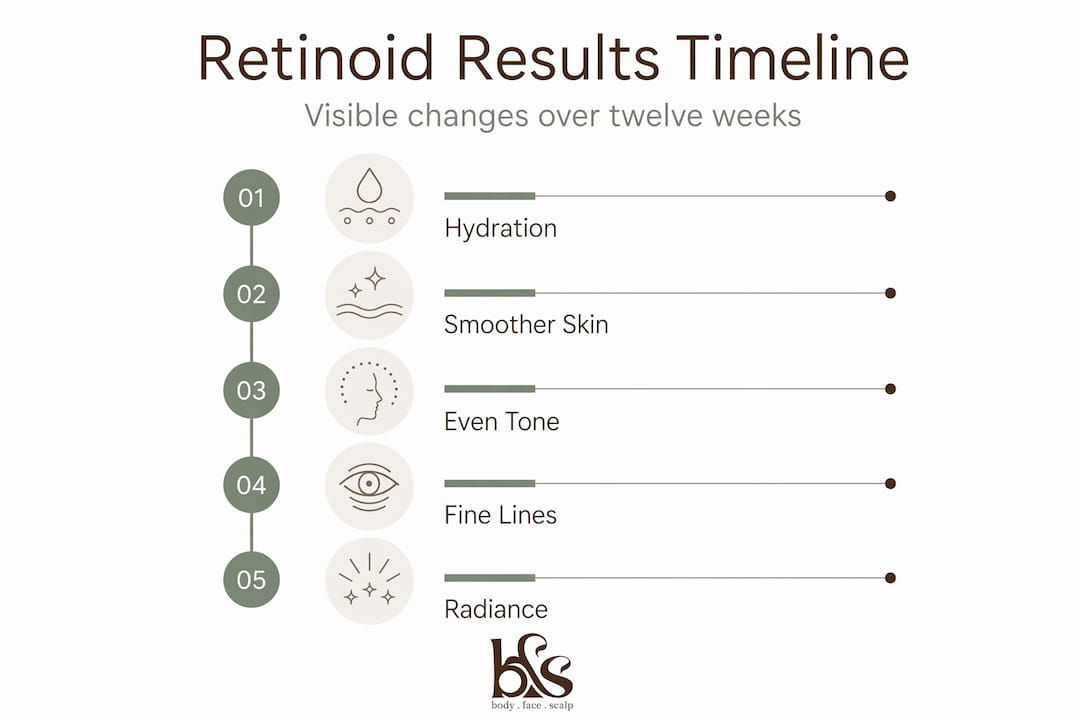
The table below outlines realistic timelines for the most common skincare goals:
| Concern | Visible improvement timeline |
|---|---|
| Dryness and dehydration | Days to two weeks with consistent moisturising |
| Redness and sensitivity | Two to four weeks with barrier-focused care |
| Hyperpigmentation and acne scars | Eight to twelve weeks with vitamin C and retinoids |
| Fine lines and texture | Eight to twelve weeks minimum with retinoids |
| Major collagen remodelling | Three to six months of consistent use |
For a practical walkthrough of layering these steps, Bodyfacescalp’s step-by-step face care guide offers clear, accessible instructions.
Troubleshooting common skincare mistakes
Even with the right products, small missteps can hold your skin back. Here are the most common ones we see, and how to correct them.
- Doing too much at once. Introducing multiple new actives simultaneously makes it impossible to know which product is causing irritation. Add one product at a time, wait two to three weeks, then add the next.
- Starting retinoids too boldly. Begin at 0.025–0.05% concentration once or twice weekly. Jumping straight to a higher concentration causes peeling, inflammation, and often a complete abandonment of the product.
- Skipping barrier repair when using actives. Retinoids and exfoliants increase skin sensitivity. Using them without adequate moisturisation wears down the barrier over time. Always follow actives with a ceramide-rich moisturiser.
- Ignoring hormonal patterns. If you are in your late thirties or forties, hormonal shifts can cause simultaneous breakouts and dryness. Balancing a hydrating barrier cream with gentle exfoliation rather than aggressive acne treatments is often more effective.
- Expecting instant results. Most prescription-level improvements take three to six months. Stopping a routine at the six-week mark because you haven’t seen dramatic change is one of the most common reasons people cycle through products without progress.
Patch testing is not just for sensitive skin types. Apply any new product to a small area near your jaw or inner arm and wait 24–48 hours before full application. It takes 60 seconds and saves weeks of irritation.
If your skin is consistently reactive, red, or breaking out despite following a structured routine, a consultation with a dermatologist or licensed esthetician is worth the investment. Some concerns, including cystic hormonal acne and stubborn melasma, respond best to prescription treatments.
Tracking progress and building habits that last
The most effective skincare routine for women in their thirties and forties is the one you can actually maintain. Consistency, not complexity, is what drives results. Research is clear that consistent, simple habits outperform sporadic use of complicated multi-step regimens.
A few habits that support long-term skin health:
- Photograph your skin monthly. Lighting matters, so take photos in the same spot with the same natural light. Changes in texture, pigmentation, and fine lines are easier to see in comparison shots than in daily reflection.
- Adjust seasonally. Canadian winters strip moisture from the skin significantly more than summer months. Your routine in January may need a richer moisturiser and gentler actives than it does in August.
- Revisit your routine every six months. Skin in your late thirties looks and behaves differently than it did at twenty-seven. Your routine should evolve with it.
- Protect consistently. SPF and barrier support are the two habits that compound over years. Everything else is correction. These two are prevention.
- Know when to simplify. If your skin is struggling, stripping back to cleanser, moisturiser, and SPF for two weeks often resets things faster than adding more products.
For those with dry or reactive skin, a checklist for sensitive and dry skin types can help identify whether your current routine is supporting or working against your barrier.
My honest take on skincare in your twenties, thirties, and forties
I’ve watched hundreds of women in this age group rebuild their skin health, and the pattern is almost always the same. They come in overwhelmed. Too many products, not enough results. And the first thing that consistently works is subtraction, not addition.
In my experience, the women who see the most dramatic changes are not the ones using the most sophisticated routines. They are the ones who commit to three or four products for six months and do not waver. The skin needs time and stability. Switching products every few weeks, chasing the newest ingredient, and abandoning routines at the first sign of adjustment period is the biggest barrier to progress I see.
What I have learned about barrier health is that it underpins everything else. You cannot expect a retinoid to remodel collagen in skin that is chronically inflamed and dehydrated. Skin barrier is the foundation. Repair it first, then introduce your actives.
My honest opinion: if you are between 25 and 40 and you can only do one thing starting today, apply SPF. Every single morning. The long-term impact of that one step outweighs almost any serum or treatment you could add. Then build from there, slowly, with patience.
— Mohid
Build your routine with Bodyfacescalp
At Bodyfacescalp, we built our formulations specifically for the challenges women in this age range face: the compromised barriers, the hormonal shifts, the need for actives that actually work without destroying skin sensitivity. Our approach is ingredient-led and results-focused.

Whether you are starting from scratch or fine-tuning what you already have, our skincare collection covers every step of the routine: gentle cleansers, barrier-restoring moisturisers built with ceramides and fatty acids, and targeted serums for hyperpigmentation and ageing. If you want a complete solution without the guesswork, our Advanced Repair Trio bundles the core repair and correction steps together. For those focused on barrier recovery specifically, our barrier restoring moisturiser is a strong starting point. Formulated for Canadian skin in Canadian conditions.
FAQ
What is the best skincare routine for women in their 30s?
A morning routine of vitamin C serum, moisturiser, and SPF 30–50, paired with an evening routine of gentle cleanser, retinoid (two to three nights per week), and a barrier-repair moisturiser covers the core needs. Consistency over eight to twelve weeks is what produces visible results.
When should women start using retinoids?
Most dermatologists recommend introducing retinoids in your mid-to-late twenties as a preventive and corrective measure. Start at a low concentration (0.025–0.05%) once weekly and increase frequency gradually as your skin adjusts.
How do you treat hormonal acne in your 30s and 40s?
Niacinamide, gentle exfoliation, and a barrier-supporting moisturiser are the foundation. Avoid harsh acne products that strip moisture, as hormonal breakouts in this age group are often accompanied by dryness. A dermatologist can assess whether prescription options like topical retinoids or oral treatments are appropriate.
How long does it take to see results from a new skincare routine?
Hydration improvements can appear within days. Texture, tone, and fine lines typically improve after eight to twelve weeks of consistent use. Major collagen remodelling from retinoids takes three to six months of regular application.
Can effective skincare for women aged 25–40 be affordable?
Yes. A foundational routine covering cleansing, targeted actives, moisturising, and SPF can be built for under $150. Focus spending on a quality moisturiser and SPF first, then add actives gradually.