


How vitamins transform your skin barrier: resilient skin
TL;DR:
- Vitamins A, C, D, and E are essential for repairing and strengthening the skin barrier.
- Niacinamide effectively boosts ceramide production, reducing water loss and improving hydration.
- A strategic, consistent routine focusing on these vitamins outperforms overloading with multiple actives.
Even the most thoughtfully curated skincare routine can fall short if it overlooks one critical factor: the right vitamins for skin barrier repair. Many women experience persistent dryness or sensitivity despite consistent moisturising, and the answer often lies beneath the surface. Vitamins A, C, D, and E each contribute to the skin barrier through antimicrobial, antioxidant, and anti-inflammatory mechanisms that no amount of hydration alone can replicate. Understanding which vitamins your skin actually needs, and how they work together, is the difference between managing symptoms and genuinely repairing your barrier. This guide walks you through the evidence and the practical steps.
Table of Contents
- Why the skin barrier matters more than you think
- The powerhouse vitamins behind a strong barrier
- Niacinamide: The multitasker for Canadian skin
- How to build a vitamin-centric skincare routine
- The truth about vitamins for skin barriers most people miss
- Explore barrier-focused solutions for skin that glows
- Frequently asked questions
Key Takeaways
| Point | Details |
|---|---|
| Vitamins power your skin barrier | A healthy skin barrier relies on vitamins like A, C, D, E, and niacinamide for defence, hydration, and repair. |
| Niacinamide boosts results fast | Niacinamide improves hydration, reduces water loss, and shows measurable repair within four weeks. |
| Ingredient synergy matters most | Pairing vitamins with ceramides and gentle actives brings superior results for dry or sensitive skin. |
| Topical application works best | Topical vitamin products outperform oral supplements for barrier repair and resilience. |
Why the skin barrier matters more than you think
Your skin barrier is the foundation of healthy skin. It is the outermost layer of your skin, known as the stratum corneum, and it functions as a protective shield against environmental aggressors, allergens, and moisture loss. When it is intact, your skin feels comfortable, balanced, and resilient. When it is compromised, everything from cold Canadian winters to overly active skincare products can trigger a cascade of dryness, redness, and irritation.
Understanding the types of skin barriers helps clarify why some people are more vulnerable to barrier breakdown than others. Several common factors contribute to a weakened barrier:
- Harsh weather conditions, particularly the cold, dry air across much of Canada
- Over-exfoliation or the use of stripping cleansers that disrupt the acid mantle
- Nutritional gaps, including insufficient vitamins that support structural skin proteins
- Ageing, which naturally reduces ceramide production and barrier efficiency
- Chronic inflammation, which erodes the tight junction proteins holding skin cells together
This is where vitamins become essential rather than optional. Barrier-focused skincare recognises that structural proteins like filaggrin, loricrin, and involucrin, which form the scaffolding of your barrier, are directly regulated by vitamins. Filaggrin, for instance, is critical for retaining moisture and keeping irritants out.
Vitamin D, through VDR (vitamin D receptor) signalling, upregulates structural proteins like filaggrin, loricrin, involucrin, and tight junction proteins, actively mitigating dryness and inflammation, particularly in ageing skin.
This means that if your skin is vitamin D deficient, no amount of moisturiser will fully compensate for the structural gaps in your barrier. The same principle applies across vitamins A, C, and E. Each one plays a distinct, irreplaceable role in keeping your barrier functional and resilient. Neglecting these nutrients makes even the best topical products measurably less effective, because they cannot do their job on a structurally compromised surface.
The powerhouse vitamins behind a strong barrier
Once you understand how central the barrier is to skin health, the next step is identifying which vitamins do the heavy lifting. Not all vitamins are equal in their effects, and knowing their distinct roles helps you make smarter choices about what goes on your skin.
Effective barrier repair ingredients consistently feature this core group of vitamins, each working through a different mechanism:
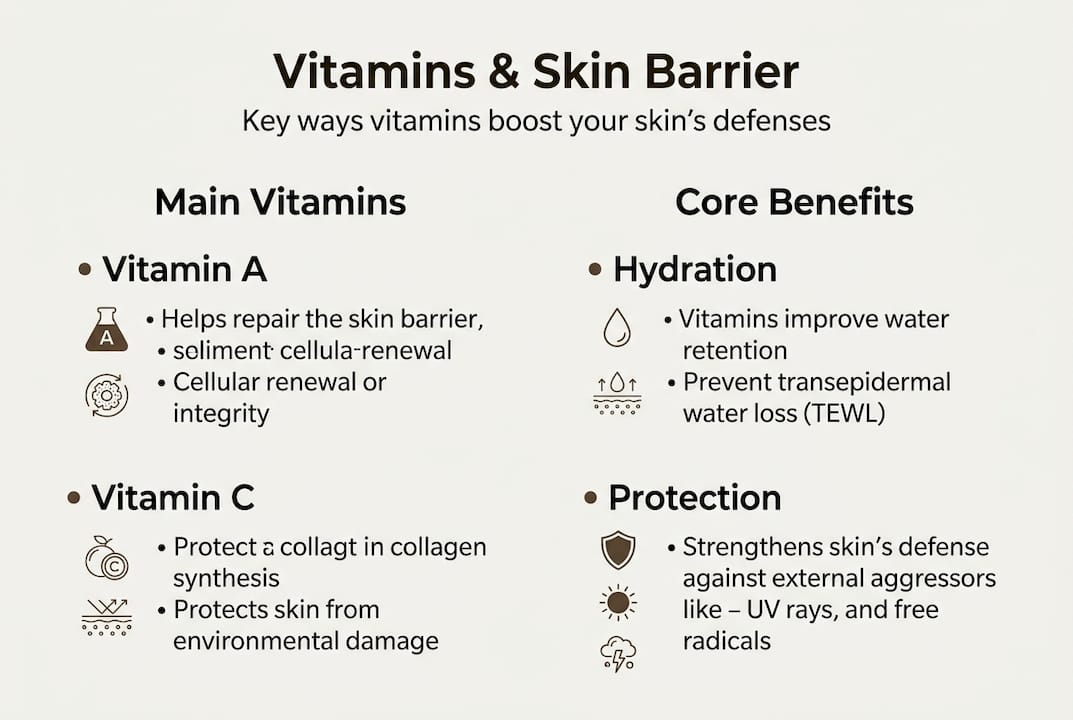
- Vitamin A (retinoids): Accelerates cellular renewal, thickens the epidermis, and supports the production of new, healthy skin cells. Retinoids are among the most studied actives in dermatology.
- Vitamin C: Acts as a cofactor for ceramide and collagen synthesis, meaning it helps your skin produce the very lipids and proteins that hold the barrier together. It also neutralises free radicals that degrade barrier integrity.
- Vitamin D: Upregulates the structural proteins discussed above and modulates immune responses in the skin, reducing inflammatory triggers that break down the barrier.
- Vitamin E (tocopherol): Delivers antioxidant protection directly within the lipid layers of the barrier, minimising oxidative damage from UV exposure and pollution.
Key ingredients for sensitive skin often combine several of these vitamins because their effects are synergistic. Vitamins A, C, D, and E each contribute distinct mechanisms that collectively support antimicrobial defence, antioxidant protection, and anti-inflammatory balance.

| Vitamin | Primary mechanism | Key benefit for barrier |
|---|---|---|
| A (retinol) | Cellular renewal | Thickens epidermis, repairs texture |
| C (ascorbic acid) | Ceramide and collagen cofactor | Stabilises barrier lipids and structure |
| D (cholecalciferol) | VDR signalling | Upregulates filaggrin and tight junctions |
| E (tocopherol) | Antioxidant in lipid layers | Reduces oxidative barrier damage |
| B3 (niacinamide) | Ceramide synthesis stimulation | Boosts hydration and reduces water loss |
Each of these vitamins addresses a different vulnerability in the barrier. Using them in combination, rather than relying on a single active, is what produces genuinely resilient skin over time.
Niacinamide: The multitasker for Canadian skin
Among all the barrier-supporting vitamins, niacinamide (Vitamin B3) stands out for the sheer breadth of its clinically documented effects. For women dealing with dryness and sensitivity in Canada’s climate, it is one of the most practical and well-supported ingredients available.
Niacinamide works by stimulating the SPT enzyme, which elevates ceramides, free fatty acids, and cholesterol within the stratum corneum. These are the three lipid categories that form the mortar between skin cells. When they are depleted, the barrier becomes porous and reactive. When they are restored, skin retains moisture more effectively and responds less dramatically to environmental stressors.
The clinical numbers are striking. Niacinamide boosts ceramide synthesis by 34 to 67%, reduces transepidermal water loss (TEWL, the rate at which moisture escapes through the skin) by 24%, and increases stratum corneum hydration by 35% at just a 2% concentration. These are not marginal improvements.
| Niacinamide concentration | Ceramide boost | TEWL reduction | Hydration increase |
|---|---|---|---|
| 2% | 34–67% | 24% | 35% |
| 5% | Clinically significant | Measurable | Noticeable in 4 weeks |
Niacinamide also pairs exceptionally well with ceramides and gentle actives. Holistic barrier repair approaches use niacinamide as a cornerstone ingredient precisely because it amplifies the effects of other barrier-supportive compounds without causing irritation. Unlike retinoids or exfoliating acids, niacinamide is well-tolerated by sensitive skin types and can be used daily.
For a barrier-focused face care workflow, niacinamide fits naturally into the serum or moisturiser step. Research also shows that niacinamide supports hydration through multiple pathways simultaneously, making it a genuinely multi-target ingredient rather than a single-function active.
Pro Tip: Look for formulas that combine niacinamide with ceramides rather than using them separately. Niacinamide stimulates the SPT enzyme, elevating ceramides, free fatty acids, and cholesterol together, which produces measurably stronger barrier repair than either ingredient alone.
How to build a vitamin-centric skincare routine
Knowing which vitamins matter is only useful if you can apply that knowledge in a practical, consistent routine. Here is how to structure a vitamin-centric approach that works for real life in Canada’s climate.
- Identify your barrier signals. Persistent tightness, flaking, redness after cleansing, or sensitivity to products you previously tolerated are all signs your barrier needs support. Start there before adding actives.
- Choose a gentle, non-stripping cleanser. Harsh surfactants undo barrier repair before it begins. Look for pH-balanced formulas that do not leave skin feeling tight.
- Apply a niacinamide serum as your first active layer. A 2 to 5% concentration applied to slightly damp skin maximises absorption and begins the ceramide-boosting process immediately.
- Follow with a barrier-restoring moisturiser that contains ceramides, vitamins C and E, and ideally vitamin D. This seals in the serum’s benefits and reinforces the lipid matrix.
- Use SPF daily. UV exposure degrades vitamin C and E in the skin and accelerates barrier breakdown. Sun protection is non-negotiable in any barrier repair routine.
- Be consistent for at least four weeks. Niacinamide and ceramide combinations outperform ceramides alone for hydration and repair, but clinical improvements require sustained use.
Pro Tip: Avoid layering strong exfoliating acids (like glycolic or salicylic) with retinoids in the same routine when your barrier is already compromised. Refer to expert solutions for sensitive skin for guidance on sequencing actives safely.
For a deeper look at ingredient selection, the barrier restoring moisturiser guide covers what to look for and what to avoid when choosing your core hydration product.
The truth about vitamins for skin barriers most people miss
Here is what we see consistently: people assume that using more vitamins, or more actives in general, will produce faster results. It rarely does. In fact, overloading a compromised barrier with too many potent ingredients often sets repair back by weeks.
What actually works is strategic layering. A routine built around a stabilised vitamin C, niacinamide at an effective concentration, and ceramides will outperform a cluttered ten-step routine almost every time. The reason is simple: each ingredient needs a functioning barrier to deliver its benefits. If the barrier is overwhelmed or irritated, absorption drops and inflammation rises.
We also want to address the oral supplement question directly. Topical vitamins show far clearer evidence for barrier repair than oral supplementation in most cases. Exceptions exist for clinical deficiencies, particularly vitamin D in populations with limited sun exposure. But for the majority of women seeking barrier improvement, what you apply to your skin matters more than what you swallow.
Consistency with evidence-based formulas, particularly those centred on emollient-focused solutions, produces the most reliable outcomes. Chasing trending ingredients is far less effective than staying committed to a routine grounded in real clinical data.
Explore barrier-focused solutions for skin that glows
Armed with a clearer understanding of how vitamins support and restore your skin barrier, the next step is finding formulas that actually deliver these ingredients at effective concentrations. At Body Face Scalp™, we formulate specifically for Canadian skin, prioritising niacinamide, ceramides, and stabilised vitamins A, C, D, and E in every product.

Our barrier-restoring moisturiser is designed to reinforce the lipid matrix and reduce water loss, while the Skin Glow Theory serum delivers a concentrated vitamin C and niacinamide blend for visible barrier improvement. Explore our full advanced skincare collection to find science-backed solutions tailored to dry, sensitive, and barrier-compromised skin. Your skin deserves ingredients that work as hard as you do.
Frequently asked questions
How do I know if my skin barrier needs vitamins?
Signs of a compromised barrier include persistent dryness, redness, irritation, or tightness despite regular moisturising. Barrier compromise responds most effectively to targeted vitamins A, C, D, and E, which address the underlying structural and inflammatory causes rather than just the surface symptoms.
What’s the best way to use niacinamide in my skincare routine?
Apply a leave-on serum or moisturiser with 2 to 5% niacinamide daily for at least four weeks. Niacinamide at 2% boosts ceramide synthesis and increases hydration measurably, and clinical benchmarks confirm noticeable barrier improvement at five weeks with consistent use.
Are oral vitamin supplements helpful for skin barrier repair?
Topical vitamins show stronger, more consistent evidence for barrier repair than oral supplements in most cases. Oral carotenoids and other supplements show inconsistent photoaging benefits compared to confirmed topical vitamin effects, with exceptions for those managing a clinical deficiency.
Is vitamin D only important in winter for Canadians?
Vitamin D supports barrier proteins and manages skin inflammation year-round, not just in winter. VDR signalling upregulates filaggrin and tight junction proteins in all seasons, making vitamin D a consistent priority for Canadian skin health regardless of sun exposure levels.
Recommended
- Barrier-focused skincare: The science of resilient skin – Body Face Scalp
- The Ultimate Guide to Barrier Restoring Moisturizer: What It Is, Why Y – Body Face Scalp
- 5 most effective barrier repair ingredients for healthy skin – Body Face Scalp
- What is a moisture barrier? Your guide to healthy skin – Body Face Scalp