


Barrier strengthening ingredients: Repair sensitive skin
TL;DR:
- Moisturisers often hydrate only the surface without repairing the deeper skin barrier, which requires specific, scientifically proven lipids. Canadian harsh climates exacerbate barrier damage, causing dryness, sensitivity, and irritation, especially when hydration escapes quickly due to lipid depletion. Effective repair ingredients include ceramides, niacinamide, fatty acids, cholesterol, and ectoin, which rebuild the skin’s structural matrix and protect against environmental stressors.
Your moisturiser may feel luxurious, but there’s a good chance it’s only hydrating the surface without actually repairing the deeper damage underneath. For Canadian women living through harsh winters, dry indoor heating, and dramatic seasonal transitions, this distinction matters enormously. A truly repaired skin barrier requires specific, scientifically proven ingredients that work at the structural level, not just on the surface. This guide cuts through the noise to show you exactly which ingredients rebuild your barrier, how they work, and why choosing the right combination makes all the difference for dry, sensitive, and reactive skin.
Table of Contents
- Understanding the skin barrier and why it fails
- Core barrier strengthening ingredients: What the science shows
- Ectoin: The secret weapon for sensitivity and environmental stress
- Smart combinations: Why ingredient synergy matters
- Why most barrier advice misses the mark: Our perspective
- Solutions for barrier repair from Body Face Scalp
- Frequently asked questions
Key Takeaways
| Point | Details |
|---|---|
| Barrier repair needs science-backed actives | Effective barrier repair comes from targeted ingredients like ceramides, niacinamide, fatty acids, and ectoin, not just moisture. |
| Synergy outperforms single ingredients | Combining lipids, vitamins, and protective compounds achieves better, longer-lasting skin results than isolated actives. |
| Canadian skin needs extra care | Harsh weather demands ingredient-rich, barrier-focused routines for optimal skin protection and healing. |
| Ectoin is a rapid relief option | Ectoin delivers fast, gentle barrier repair especially for sensitive or environmentally stressed skin. |
| Right layering makes a difference | Proper ingredient order maximises repair, so start with serums and finish with lipid-rich creams. |
Understanding the skin barrier and why it fails
Your skin barrier, formally known as the stratum corneum, is the outermost layer of your skin. Think of it as a brick wall: the skin cells are the bricks, and a structured matrix of lipids (fats) acts as the mortar holding everything together. This layer is your primary defence against moisture loss, irritants, pollutants, and environmental aggressors.
When this lipid matrix is intact, your skin stays hydrated, calm, and resilient. When it’s compromised, water escapes freely through a process called transepidermal water loss (TEWL). TEWL is simply the measurement of how much moisture your skin loses to the environment. High TEWL signals a struggling barrier.
Understanding the types of skin barriers helps you recognise where your own skin fits and what it genuinely needs to restore healthy skin function.
Canadian winters are particularly punishing. Cold outdoor air holds very little moisture, while heated indoor environments strip whatever humidity remains. This cycle of cold and dry creates a relentless assault on the barrier. The result is skin that feels tight, rough, and reactive even when you’re applying moisturiser regularly.
Common signs your barrier is compromised include:
- Persistent dryness or tightness, even after moisturising
- Flaking or peeling skin, particularly around the nose and cheeks
- Redness and visible sensitivity to products that never bothered you before
- Stinging or burning when applying serums or cleansers
- Uneven skin tone and a rough or dull texture
Here’s the critical problem with many standard moisturisers: they often rely heavily on humectants like glycerin and hyaluronic acid, which draw water into the skin. These are valuable ingredients, but they don’t rebuild the structural lipid matrix that’s actually been damaged.
“Ceramides are essential lipids that replenish the skin’s natural moisture barrier, reducing transepidermal water loss and restoring integrity, particularly effective for dry and sensitive skin.”
Real repair requires barrier-identical lipids — ingredients that mirror what your skin naturally produces. Without them, hydration escapes as quickly as you apply it.
Core barrier strengthening ingredients: What the science shows
Knowing the challenges of maintaining a resilient barrier, let’s explore which ingredients are backed by research to make a real difference.
The most important category for barrier repair is lipids, specifically ceramides, cholesterol, and fatty acids. These three components make up the majority of the skin’s natural lipid matrix, and replenishing them topically has measurable clinical benefits.
Ceramides are the star of the group. They account for approximately 50% of the skin’s lipid composition and are the first line of defence against moisture loss. Topically applied ceramides directly replenish this matrix and reduce TEWL in both healthy and compromised skin. Not all ceramides are created equal — research shows that longer-chain ceramides (C24 to C30) provide superior barrier recovery compared to shorter-chain versions, making the specific ceramide type in your product worth noting.

Niacinamide (vitamin B3) is one of the most well-researched skincare actives available. It works differently from ceramides — rather than replacing lipids directly, niacinamide triggers your skin to produce its own ceramides. Specifically, niacinamide stimulates endogenous ceramide synthesis in the stratum corneum by 34 to 67% at concentrations of 2 to 5%, while also increasing hydration by 35% and reducing TEWL by 24%. This makes it a powerful complement to topical ceramides, addressing the barrier from both internal and external angles.
Fatty acids, particularly linoleic acid, are essential for lipid integrity and moisture retention. Importantly, fatty acids are among the first compounds depleted in damaged or inflamed skin, which is why replenishing them is non-negotiable in a repair-focused formula.
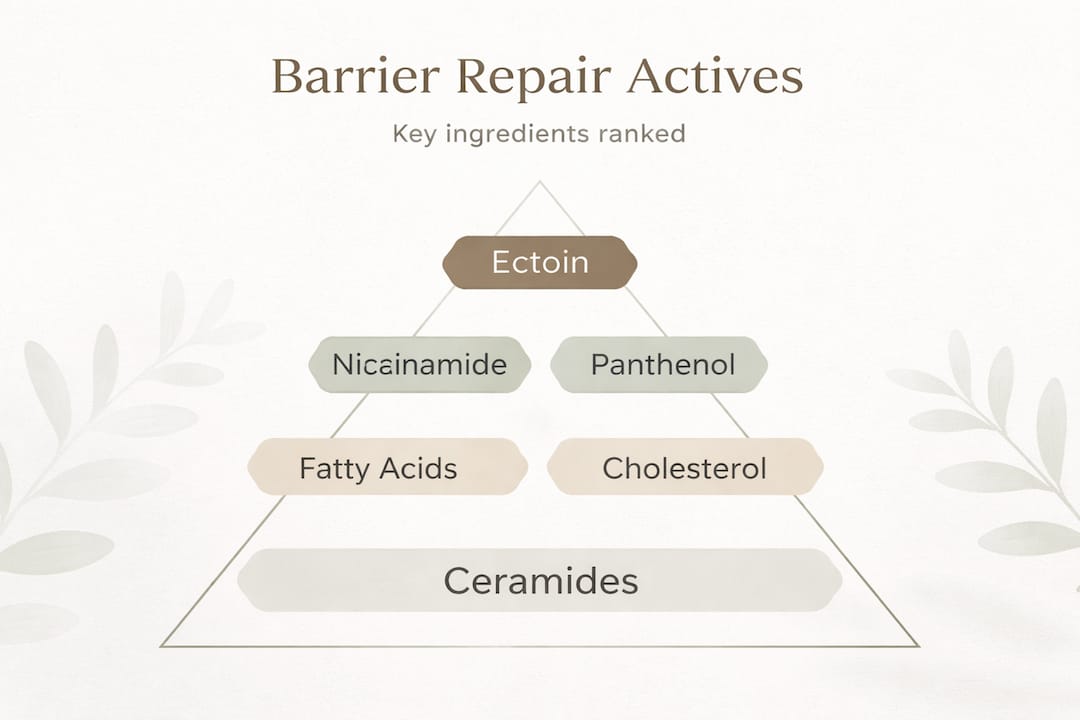
Panthenol (vitamin B5) rounds out the core actives beautifully. It reduces inflammation, accelerates healing, and improves barrier flexibility by maintaining skin suppleness.
Here’s how the key ingredients compare at a glance:
| Ingredient | Primary action | Key benefit | Optimal concentration |
|---|---|---|---|
| Ceramides | Replaces lipid matrix | Reduces TEWL directly | 0.5–2% (complex) |
| Niacinamide | Stimulates ceramide synthesis | Boosts hydration, reduces TEWL | 2–5% |
| Linoleic acid | Restores fatty acid balance | Supports lipid integrity | 1–3% |
| Cholesterol | Completes lipid ratio | Enhances ceramide absorption | Part of physiologic ratio |
| Panthenol | Anti-inflammatory, healing | Improves flexibility | 1–5% |
| Ectoin | Stabilises proteins, hydro-complex | Rapid sensitivity relief | 5–7% |
When reading an ingredient list, look for these under their INCI names: ceramide NP, ceramide AP, ceramide EOP, niacinamide, linoleic acid, cholesterol, and panthenol. You can learn more about identifying effective barrier repair ingredients to shop more confidently.
It’s also worth understanding the difference between humectants and barrier-repair actives:
- Humectants (hyaluronic acid, glycerin, urea): Draw water into the skin. They hydrate but do not rebuild the lipid structure.
- Barrier-repair actives (ceramides, fatty acids, cholesterol): Rebuild the structural matrix. They address the root cause of moisture loss.
- Emollients: Sit between skin cells to smooth and soften. Some also assist with barrier repair when they are lipid-rich.
Pro Tip: When choosing a niacinamide product, confirm the concentration is at least 2%. Many products list niacinamide prominently but include it at a level too low to stimulate ceramide production. Check out niacinamide’s role in skin barrier health for a deeper look. Also explore ingredients for sensitive Canadian skin to ensure what you’re applying is appropriate for your skin type.
Ectoin: The secret weapon for sensitivity and environmental stress
Beyond classic lipids and vitamins, let’s spotlight an innovative ingredient making waves in barrier repair.
Ectoin is a naturally derived molecule originally found in extremophile microorganisms — bacteria that survive in extreme environments like salt lakes and hot springs. These organisms produce ectoin to protect their cellular structures under harsh conditions. When applied to skin, ectoin forms what researchers call a protective hydro-complex around proteins and cell membranes, stabilising them against environmental damage.
For Canadian women dealing with irritation, eczema, or weather-induced sensitivity, the clinical data on ectoin is genuinely impressive.
| Outcome measured | Result with ectoin (5–7%) | Timeframe |
|---|---|---|
| Atopic dermatitis SCORAD (severity score) | Reduced by 64% | 4 weeks |
| TEWL reduction | 23.9% decrease | 4 weeks |
| Skin hydration increase | 15.1% improvement | 4 weeks |
| Mechanism | Hydro-complex protein stabilisation | Ongoing |
The SCORAD is a standardised clinical tool used by dermatologists to measure the severity of atopic dermatitis (eczema). A 64% reduction in four weeks is a clinically meaningful result, particularly for those who have struggled with flare-ups throughout the colder months.
What makes ectoin especially relevant for Canadians is that it delivers these results without steroids. Many people with sensitive or eczema-prone skin are understandably cautious about long-term steroid use due to thinning of the skin over time. Ectoin offers a steroid-free path to rapid calming and barrier stabilisation that pairs beautifully with panthenol for enhanced anti-inflammatory and healing support.
Ectoin also shows particular promise for protecting the barrier against environmental stressors — UV exposure, pollution, and cold wind — making it a smart inclusion in products designed for Canadian conditions.
To identify ectoin on a product label, look for it listed simply as “ectoin” in the INCI ingredient list. It’s often positioned mid-list, reflecting its active concentration rather than filler use. You can learn more about incorporating it into your routine through guidance on sensitive skin repair ingredients.
Pro Tip: If your skin becomes reactive during the winter months specifically, prioritise a product containing ectoin alongside ceramides rather than reaching for a heavier occlusive alone. The ectoin addresses the inflammatory and structural damage simultaneously.
Smart combinations: Why ingredient synergy matters
After seeing how unique ingredients work, it’s critical to understand that real results come from strategic combinations, not from isolated actives.
The most compelling research supports what is called a physiologic lipid ratio: ceramides, cholesterol, and fatty acids applied together in proportions that mirror the skin’s own composition. Clinical studies confirm that ceramide moisturisers reduce TEWL and improve hydration in atopic dermatitis, with results showing that physiologic ratios with cholesterol outperform single ingredients used in isolation. Using ceramides alone without cholesterol and fatty acids doesn’t fully restore the barrier’s structural matrix, because all three components are needed to rebuild the lipid architecture correctly.
Here’s how to think about layering for maximum effect:
- Cleanse gently: Use a pH-balanced cleanser that doesn’t strip your natural lipids. Avoid sulphate-heavy foaming cleansers on dry or sensitive skin.
- Apply a niacinamide serum: Niacinamide is water-based and absorbs quickly. Apply it first so it can penetrate and begin stimulating ceramide production.
- Follow with an ectoin-containing treatment: If your skin is reactive or in a compromised state, layer this after your serum for rapid stabilisation.
- Apply a lipid-rich moisturiser: Look for a product that contains the full physiologic trio of ceramides, cholesterol, and fatty acids to seal in all previous layers and rebuild the matrix.
- Use an occlusive if needed in winter: In very dry or cold Canadian conditions, a thin layer of an occlusive like shea butter or squalane on top locks everything in overnight.
The ordering logic here matters. Water-based actives like niacinamide must go on first, before thicker lipid-rich creams, or they can’t penetrate effectively. Applying a heavy ceramide cream before a serum is like painting over a sealed surface — the active simply sits on top instead of absorbing.
“Barrier strengthening prioritizes skin-identical lipids — ceramides, cholesterol, fatty acids — over humectants alone; niacinamide boosts endogenous synthesis for sustained repair.”
When reading labels while shopping, look for products where ceramides appear in the first half of the ingredient list. An ingredient listed near the bottom is likely present in a concentration too low to deliver measurable results. Understanding the full picture of barrier-focused skincare science helps you make genuinely informed choices. For a practical reference, the barrier restoring moisturiser guide walks through what to look for product by product.
Pro Tip: When evaluating a new moisturiser, compare its first ten ingredients against the physiologic lipid checklist: ceramide, cholesterol, and a fatty acid source. If only one of the three is present, the formula may hydrate but won’t fully repair.
Why most barrier advice misses the mark: Our perspective
We work with a lot of Canadians who have spent years following mainstream skincare advice and still can’t get their skin stable. The frustration is real, and in our experience, it comes down to a few consistent gaps that the general skincare conversation doesn’t address honestly enough.
First, most generic advice treats all moisturisers as essentially equivalent, differing only in thickness or texture. This overlooks the fundamental distinction between hydrating ingredients and barrier-rebuilding ingredients. You can drink water all day and still be dehydrated at a cellular level if something is wrong with your body’s fluid regulation. The same principle applies to skin: humectants add water, but if your lipid matrix is depleted, that water leaves almost immediately.
Second, dosage and concentration are almost never discussed publicly. Niacinamide at 0.5% is not the same as niacinamide at 4%. Ceramides listed as the very last ingredient on a product are present in trace amounts that won’t produce a clinical result. The beauty industry benefits from consumers not knowing this, because it allows lower-cost formulations to be marketed with the same ingredient claims as more rigorously dosed products. We think you deserve to know the difference.
Third, the Canadian climate specifically demands richer, more occlusive formulations than what most international skincare advice recommends. Guidance written for temperate European climates or humid Asian environments doesn’t account for what your skin experiences during a Canadian February. Your barrier needs thicker lipid support here, particularly from November through March.
Finally, many Canadians unknowingly undo their barrier work by using exfoliants too frequently without compensating with enough lipid repair. Gentle exfoliation has a place in a healthy routine, but frequency and sequencing matter enormously. Exfoliating without immediately following with a lipid-rich repair product leaves the barrier open and vulnerable.
The practical takeaway: prioritise complete lipid formulas over ingredient trend-chasing, verify concentrations where possible, and adjust your routine seasonally to match Canada’s climate realities.
Solutions for barrier repair from Body Face Scalp
For those seeking to put this guidance into action, here’s where to find carefully formulated products that prioritise barrier integrity.
At Body Face Scalp, we formulate specifically for the Canadian skin experience. Our products are built around the physiologic lipid trio of ceramides, cholesterol, and fatty acids, combined with clinically dosed niacinamide and skin-calming actives like ectoin and panthenol.
Every product in our skin care collection is designed with barrier repair as the core objective, not as an afterthought. Our Barrier Restoring Moisturiser brings together the full complement of barrier-identical lipids in a format suited to Canada’s challenging climate. Browse our full skincare range to find formulas matched to your specific concerns, whether that’s dryness, sensitivity, hyperpigmentation, or a combination of all three.
Frequently asked questions
What are the best ingredients for repairing a damaged skin barrier?
Ceramides, niacinamide, fatty acids, cholesterol, panthenol, and ectoin are the most evidence-backed ingredients for strengthening and repairing a compromised skin barrier. Clinically proven effects have been demonstrated for all of these actives in peer-reviewed research.
How can I tell if my moisturiser helps strengthen my skin barrier?
Look for ceramides, cholesterol, fatty acids, niacinamide, and ectoin in the first half of the ingredient list, and confirm concentrations where possible. Products with skin-identical lipids and niacinamide deliver sustained barrier improvement rather than short-term hydration.
Is ectoin suitable for sensitive or eczema-prone skin?
Yes, clinical data shows ectoin rapidly calms sensitivity, reduces irritation and TEWL, and helps manage atopic dermatitis safely and without steroids. Ectoin at 5–7% reduces atopic dermatitis severity and supports measurable hydration improvements within four weeks.
Does ingredient order matter when using multiple barrier actives?
For best results, apply lightweight water-based serums (such as niacinamide) first, then layer lipid-rich creams containing ceramides and fatty acids to seal in the treatment benefits and rebuild the matrix.
Can I over-strengthen my skin barrier?
Most people don’t risk this with standard barrier repair products; however, consistently overusing heavy occlusives can occasionally cause congestion or milia, so balance your routine and adjust based on how your skin responds.
Recommended
- Skin repair: 5 key ingredients for sensitive Canadian skin – Body Face Scalp
- 5 most effective barrier repair ingredients for healthy skin – Body Face Scalp
- Barrier repair explained: restore healthy skin, reduce dryness – Body Face Scalp
- Barrier-focused skincare: The science of resilient skin – Body Face Scalp
- 10 Best Products for Skin Barrier Repair
- 6 Top Skin Repair Ingredients and How They Work for You – Cellure