


5 most effective barrier repair ingredients for healthy skin
Dryness, tightness, and sensitivity are not just annoyances. For many Canadians, they are the daily reality of living in one of the harshest climates for skin health. Temperatures swing from brutal winter cold to dry indoor heating, and your skin barrier takes the hit every time. The market is full of products that promise barrier repair, but the real difference lies in which ingredients are doing the work and how they work together. This guide walks you through the most powerful barrier-repairing ingredients available, what each one does, and how to choose the right combination for your specific skin needs and Canadian climate realities.
Table of Contents
-
Lipid-rich barrier builders: Ceramides, squalane, and phytosterols
-
Targeted actives: Panthenol, niacinamide, and advanced peptides
-
Why most barrier care advice misses the mark for Canadian skin
Key Takeaways
| Point | Details |
|---|---|
| Layer ingredients wisely | Combining humectants and lipids creates an effective barrier in dry Canadian conditions. |
| Prioritise ceramides and squalane | These biomimetic lipids offer lasting protection and rebuilding without blocking pores. |
| Actives enhance resilience | Modern actives like panthenol and niacinamide speed recovery and comfort for sensitive skin. |
| Adapt for climate | Switch routines seasonally—use more lipids and barrier boosters in harsh Canadian winters. |
What makes an ingredient barrier-repairing?
Your skin barrier, known clinically as the stratum corneum, is the outermost layer of your skin. Think of it as a brick wall: skin cells are the bricks, and lipids (fats) are the mortar holding everything together. When that mortar breaks down, moisture escapes and irritants get in. Understanding your skin barrier is the first step to choosing ingredients that genuinely repair it.
Not every moisturising ingredient qualifies as barrier-repairing. We categorise effective ingredients into four functional types:
-
Occlusives: Form a physical seal on the skin’s surface to prevent water loss. Examples include petrolatum, beeswax, and dimethicone.
-
Emollients: Fill the gaps between skin cells, smoothing texture and improving flexibility. Examples include squalane, shea butter, and fatty acids.
-
Humectants: Draw moisture into the skin from the air or deeper skin layers. Examples include glycerin, hyaluronic acid, and panthenol.
-
Actives: Stimulate biological repair processes, such as ceramide synthesis or collagen production. Examples include niacinamide, peptides, and panthenol.
The real power comes from combining these categories. Using a single ingredient type rarely delivers lasting results, especially in Canada’s dry, cold air. This is where the humectant sandwich method becomes essential: apply a humectant first to draw moisture in, follow with an emollient to smooth and soften, then seal with an occlusive to lock everything in place.
One critical caution: humectants alone can draw water out of the skin when the surrounding air is drier than your skin, which is exactly what happens during Canadian winters. Without a lipid seal on top, you may actually increase water loss.
Pro Tip: Always apply your occlusive as the final step in your routine, particularly in low-humidity environments. This simple habit can significantly reduce transepidermal water loss (TEWL), the process by which water evaporates through the skin.
Lipid-rich barrier builders: Ceramides, squalane, and phytosterols
Lipids are the cornerstone of true barrier repair. They are the structural components your skin needs to stay intact, and replenishing them is the most direct path to recovery.
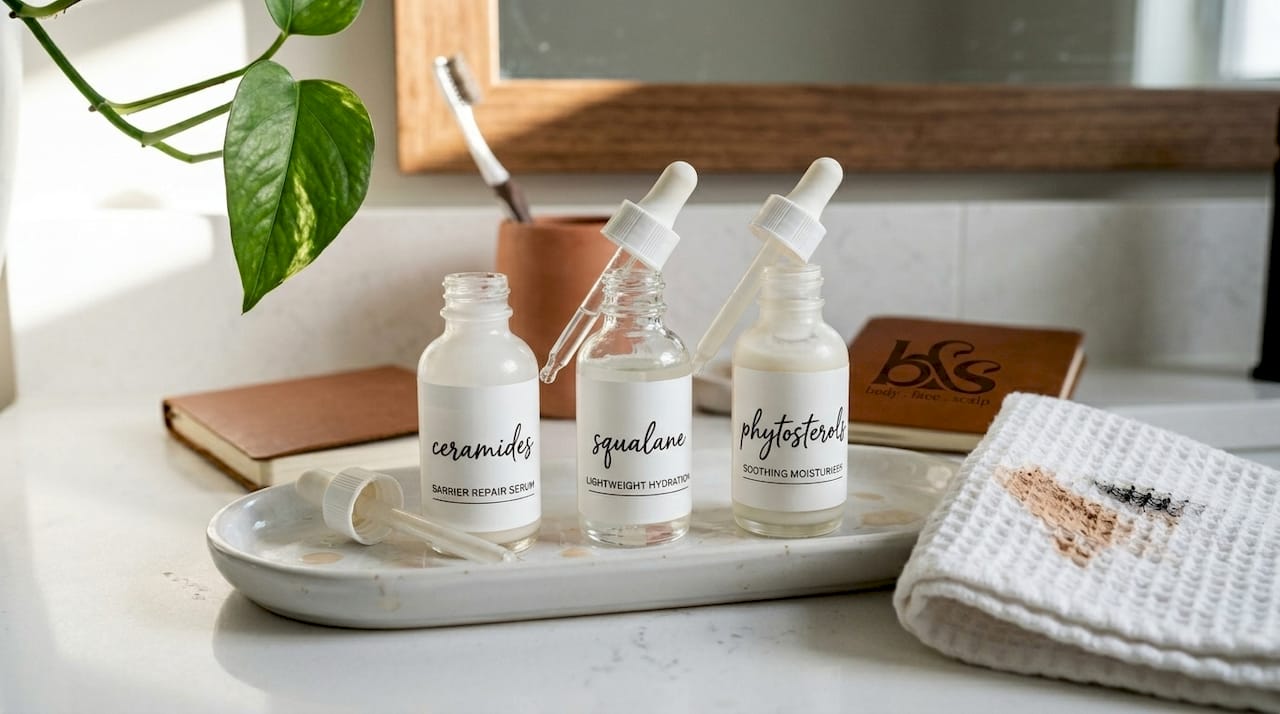
Ceramides are naturally occurring lipids that make up roughly 50% of your skin’s barrier. They act as the primary mortar in that brick-wall structure. Not all ceramides are equal: ultra-long-chain ceramides (C24-C30) outperform short-chain versions for true barrier recovery. For Canadians dealing with chronic dryness, this distinction matters when reading product labels.
Squalane is a lightweight, stable oil derived from olives or sugarcane. It closely mimics your skin’s natural sebum, making it exceptionally well-tolerated. Squalane and phytosterols provide breathable emollience and actively rebuild the barrier with minimal risk of acne, making them ideal for sensitive or acne-prone skin.
Phytosterols are plant-derived lipids that reinforce the barrier and reduce inflammation. They work synergistically with ceramides and squalane in premium formulations.
Here is a quick comparison of the top lipid options:
| Ingredient | Comedogenicity | Rebuilding speed | Best for |
|---|---|---|---|
| Ceramides | Very low | Moderate to fast | All skin types, especially dry/sensitive |
| Squalane | Very low | Moderate | Acne-prone, sensitive, oily |
| Petrolatum | Low | Fast (occlusive only) | Severely dry, eczema-prone |
Top lipid-based ingredients to look for:
-
Ceramide NP, AP, EOP: The most researched ceramide types for barrier repair
-
Squalane: Lightweight, non-greasy, non-comedogenic
-
Phytosterols: Anti-inflammatory and barrier-reinforcing
-
Fatty acids (linoleic, oleic): Fill lipid gaps and restore suppleness
For best results, look for emollient barrier repair formulas that combine ceramides with squalane in a balanced ratio. Premium brands use a 2:4:2 lipid ratio (ceramides, cholesterol, fatty acids) to mimic the skin’s natural composition. Explore ceramide-rich moisturisers that deliver this kind of precision.
Smart hydrators: Humectants and the need for a lipid seal
Humectants hydrate by attracting water molecules and binding them to the skin. They are essential for plumpness and suppleness. But in Canada’s climate, they come with a critical caveat.
Humectants alone can actually draw water out of the skin in dry or low humidity conditions, which is especially relevant for Canadian winters. When the air outside is at 20% humidity or less, humectants pull moisture from your skin’s deeper layers rather than the air, worsening TEWL.
The solution is layering. Here is how to apply humectants effectively:
-
Cleanse with a gentle, non-stripping cleanser to start with a clean base.
-
Apply humectant (glycerin serum or hyaluronic acid) to slightly damp skin to maximise moisture uptake.
-
Layer an emollient such as a squalane-based cream to smooth and fill the barrier.
-
Seal with an occlusive such as a ceramide-rich moisturiser or a thin layer of petrolatum on very dry areas.
This is the humectant sandwich in action. It is the most effective method for using barrier-restoring moisturisers in a cold, dry environment.
Here is how key humectants perform across climates:
| Humectant | Dry climate performance | Humid climate performance | Best pairing |
|---|---|---|---|
| Glycerin | Needs occlusive seal | Excellent alone | Ceramide cream |
| Hyaluronic acid | Needs occlusive seal | Very good | Squalane or petrolatum |
| Panthenol | Good (also an active) | Excellent | Any lipid-rich formula |
| Urea | Excellent (keratolytic) | Good | Emollient-rich cream |
Pro Tip: For a holistic barrier repair approach, apply your humectant serum within 60 seconds of washing your face. Damp skin absorbs humectants more efficiently, and sealing immediately after prevents any moisture from escaping.
Targeted actives: Panthenol, niacinamide, and advanced peptides
Hydration and lipid replenishment set the foundation, but targeted actives take barrier repair further by stimulating your skin’s own repair mechanisms.
Panthenol (provitamin B5) is one of the most well-supported actives for barrier recovery. At 5% concentration, panthenol boosts ceramide production by 18 to 25%, speeds wound closure, and reduces TEWL by up to 42%. It also calms irritation and redness, making it ideal for post-procedure skin or anyone dealing with sensitivity.
“Panthenol at 5% increases ceramides up to 25%, reducing TEWL by up to 42%” — a clinically meaningful result for anyone managing a compromised barrier in Canada’s climate.
Niacinamide (vitamin B3) is a multi-tasking active that plasticises keratin and supports flexibility, which is especially valuable in dry Canadian conditions where skin can become rigid and prone to cracking. It also reduces inflammation, minimises pores, and evens skin tone.
Peptides are short chains of amino acids that signal skin cells to produce more collagen and repair proteins. Newer multi-peptide blends in premium formulations target barrier proteins specifically, offering a next-level approach for those seeking sensitive skin expert solutions.
Key actives and their roles:
-
Panthenol (5%): Boosts ceramide synthesis, reduces TEWL, calms irritation
-
Niacinamide (4 to 10%): Strengthens barrier flexibility, reduces redness, improves tone
-
Copper peptides: Stimulate barrier protein repair and collagen production
-
Palmitoyl tripeptide-1: Supports structural skin proteins for long-term resilience
To integrate these actives effectively, apply your panthenol or niacinamide serum after cleansing and before your moisturiser. Explore multi-peptide serums that combine several of these actives in one step for a streamlined routine.
Ingredient comparison and how to choose for Canadian skin
With so many ingredients available, the key is matching the right combination to your skin type and the specific climate challenge you face. In Canadian winters, lipid-replenishers and ceramide boosters are more critical than humectants alone.
Here is a practical comparison by skin concern and climate:
| Skin concern | Priority ingredients | Secondary support |
|---|---|---|
| Severe dryness, winter | Ceramides, petrolatum, phytosterols | Glycerin, panthenol |
| Sensitivity or redness | Squalane, panthenol, niacinamide | Ceramide NP, phytosterols |
| Acne-prone, dry climate | Squalane, niacinamide, hyaluronic acid | Ceramides (non-comedogenic) |
| General barrier maintenance | Ceramides, glycerin, niacinamide | Peptides, fatty acids |
Optimal combinations by scenario:
-
Facing temperatures below minus 20°C: Prioritise ceramides plus petrolatum or a rich occlusive, with panthenol underneath for active repair.
-
Dry, sensitive skin year-round: Layer squalane with niacinamide and a ceramide-rich moisturiser for daily resilience.
-
Acne-prone skin in winter: Use a squalane-based emollient with low-concentration niacinamide and hyaluronic acid sealed with a lightweight ceramide cream.
-
Post-travel or post-procedure recovery: Lead with 5% panthenol, follow with ceramide-rich cream, and avoid actives that increase sensitivity.
For a routine for sensitive skin that incorporates these principles, start simple: one humectant, one emollient, one occlusive. Add actives one at a time to monitor how your skin responds.
Why most barrier care advice misses the mark for Canadian skin
Most skincare advice is written for temperate climates. It assumes you live somewhere with moderate humidity and mild winters. In Canada, that assumption fails you regularly.
Generic barrier repair advice often focuses on humectants and light moisturisers, which are perfectly fine in Vancouver’s mild winters but genuinely inadequate in Calgary or Winnipeg in January. Cold, dry air amplifies barrier loss at a rate that light hydrators simply cannot offset on their own.
What we have learned, formulating specifically for Canadian skin, is that biomimetic lipid blends, those that closely replicate the skin’s natural lipid profile, deliver results that generic moisturisers cannot match. The ratio of ceramides to cholesterol to fatty acids matters. The chain length of ceramides matters. These are not marketing details. They are the difference between a product that works and one that feels nice but leaves your barrier still struggling.
Our honest take: do not skip reading ingredient labels. Synergy and ratio matter more than sheer quantity. A formula with three well-chosen lipids in the right proportions will outperform one with ten ingredients at trace amounts. For year-round resilience in Canada, explore seasonal skincare strategies that shift your routine as the climate shifts.
Upgrade your skincare with barrier-repairing formulas
You now have a clear picture of which ingredients repair your barrier, how they work together, and how to choose the right combination for your skin and Canada’s climate. The next step is putting that knowledge into practice with formulations designed around these exact principles.

At Body Face Scalp™, every product in our skin care collection is built around ingredient synergy and barrier science. Our barrier restoring moisturiser delivers ceramides, squalane, and panthenol in clinically informed ratios, designed specifically for the demands of Canadian skin. Whether you are managing dryness, sensitivity, or year-round barrier stress, explore our barrier-focused skincare solutions to find your ideal routine.
Frequently asked questions
What are the most effective barrier repair ingredients for Canadian winters?
Focus on ceramides, squalane, phytosterols, and panthenol, as they replenish lipids and strengthen your skin in cold, dry conditions. Lipid-replenishers and ceramide boosters are especially critical during Canadian winters when humectants alone fall short.
Can humectants like hyaluronic acid repair the skin barrier on their own?
No. Humectants hydrate but require a lipid layer to seal in moisture and prevent water loss, particularly in dry climates. Without that seal, humectants alone can draw water out of the skin in low-humidity conditions.
Is squalane better than petrolatum for acne-prone skin?
Yes. Squalane provides breathable moisturising without congestion, making it a better choice for acne-prone or sensitive skin. Squalane and phytosterols provide breathable emollience with minimal risk of acne.
How quickly can panthenol repair a damaged skin barrier?
At 5% concentration, panthenol can accelerate barrier repair meaningfully. 5% panthenol boosts ceramide production by 18 to 25%, speeds wound closure, and reduces TEWL by up to 42%, with measurable improvement possible within days of consistent use.
Recommended
-
Understand types of skin barriers for healthier skin – Body Face Scalp
-
Emollients for barrier repair: ingredient-led solutions that work – Body Face Scalp
-
The Ultimate Guide to Barrier Restoring Moisturizer: What It Is, Why Y – Body Face Scalp
-
Holistic barrier repair for resilient Canadian skin in 2026 – Body Face Scalp