


Is niacinamide good for daily use? a clear guide
TL;DR:
- Niacinamide is a safe, versatile active suitable for daily use across all skin types, including sensitive skin. It effectively repairs the skin barrier, regulates sebum, reduces redness, and brightens skin tone, with visible results developing over 2 to 16 weeks of consistent application. The optimal concentration is 4–5%, and it pairs well with other actives such as retinoids, hyaluronic acid, and ceramides.
Niacinamide is defined as the active form of vitamin B3 and is safe for daily use across virtually all skin types, including sensitive, dry, and oily. Dermatologists consistently rank it among the most tolerable actives in modern skincare, and clinical studies back that reputation. Whether you are managing dryness in a Canadian winter, dealing with post-summer hyperpigmentation, or trying to calm a reactive complexion, niacinamide belongs in your daily routine. This guide covers the core benefits, the right concentrations, realistic timelines, and exactly how to layer it with other actives.
Is niacinamide good for daily use? what the evidence says
Niacinamide is good for daily use because it addresses multiple skin concerns simultaneously without the irritation risk that comes with stronger actives like retinoids or AHAs. That versatility is what separates it from most other ingredients in the skincare category.

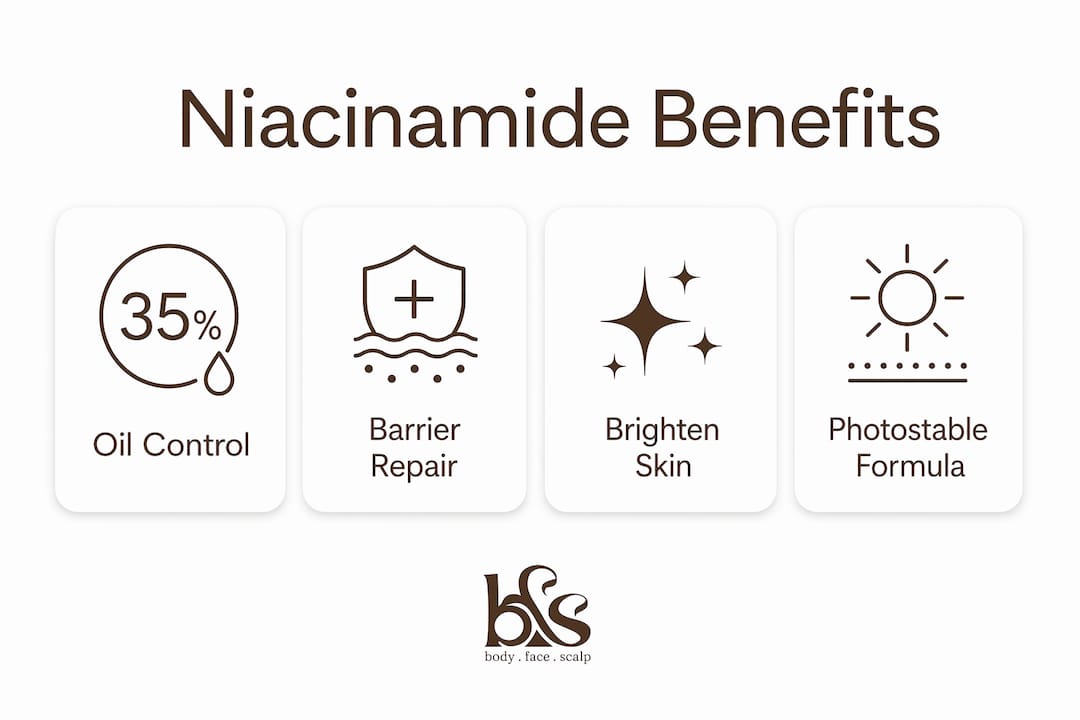
The evidence is clear. Regular daily application reduces oil production by up to 35% while preserving the skin’s natural barrier function. That means you are not trading hydration for sebum control. For oily and combination skin types, this balance is particularly valuable.
Niacinamide is also photostable. Unlike vitamin C, which degrades quickly under heat and UV exposure, niacinamide remains stable in sunlight and does not sensitise the skin to UV rays. This makes it equally suitable for morning and evening application, and it performs reliably whether you are using it in summer or through a cold Canadian February.
For anyone with dry or sensitive skin, the barrier-repair function is the most important benefit. Niacinamide stimulates ceramide and fatty acid synthesis, which are the structural lipids that hold your skin barrier together. A stronger barrier means less water escaping through the skin and less environmental irritation getting in.
What are the core benefits of niacinamide for skin?
The benefits of niacinamide are well-documented across clinical literature, and they span several skin concerns at once. Here is what consistent daily use delivers:
- Barrier repair: Niacinamide stimulates ceramide production, which reduces transepidermal water loss by up to 30% within weeks. A repaired barrier is the foundation for addressing every other skin concern.
- Hydration retention: By reducing water loss, the skin stays more hydrated throughout the day without requiring heavy occlusive products.
- Sebum regulation: Niacinamide for oily skin is one of its most studied applications. It reduces excess oil production without stripping the skin, which prevents the rebound oiliness that harsh cleansers often trigger.
- Redness and inflammation reduction: For rosacea-prone or reactive skin, niacinamide calms visible redness and reduces inflammatory responses over time.
- Brightening and tone correction: Niacinamide inhibits the transfer of melanin to skin cells, which gradually fades dark spots and evens skin tone. This is a secondary benefit that builds on a repaired barrier, not a standalone effect.
- Fine line support: At consistent concentrations, niacinamide improves skin texture and reduces the appearance of fine lines by supporting overall skin health.
The brightening properties are real, but they are secondary to barrier repair. Brightening results depend on a healthy, functioning barrier first. If your skin is compromised, address that before expecting tone correction. Bodyfacescalp’s approach to formulation reflects exactly this priority: repair the barrier, then target secondary concerns.
What concentration of niacinamide is best for daily use?
The niacinamide dosage for face matters more than most people realise. Choosing the wrong concentration is the most common reason people either see no results or experience unnecessary irritation.
| Concentration | Best For | Expected Benefits | Tolerability |
|---|---|---|---|
| 2–3% | Sensitive, reactive, or first-time users | Gentle barrier support, mild hydration boost | Very high |
| 4–5% | Most skin types, including dry and combination | Full barrier repair, sebum control, early brightening | High |
| 8–10% | Oily or acne-prone skin with established tolerance | Stronger sebum regulation, more pronounced brightening | Moderate |
The 4–5% concentration range is the most studied and delivers the best balance of efficacy and tolerability. Many commercial products, including those formulated for Canadian skin conditions, use this range precisely because it outperforms higher strengths without the risk of transient redness or burning.
Higher concentrations, up to 10%, do exist. However, concentrations above 5% increase irritation risk without delivering proportionally greater benefits. For most people, 10% is unnecessary and may cause discomfort, particularly for dry or sensitive skin.
Pro Tip: If you are new to niacinamide or have reactive skin, start with a 2–3% product for the first two weeks. Once your skin adapts, move to a 4–5% formulation. Tolerance and adaptation typically occur within 1–2 weeks of daily application.
How long does niacinamide take to show results?
Patience is the most underrated part of any niacinamide skincare routine. Results are real, but they follow a predictable timeline that requires consistent daily application.
- Weeks 2–4: Hydration improves and the skin feels less tight or reactive. Barrier function begins to strengthen, and redness may visibly reduce. These are the earliest signs that the ingredient is working.
- Weeks 4–8: Sebum regulation becomes noticeable. Oily skin types will see a reduction in midday shine. Skin texture starts to smooth out.
- Weeks 8–12: Fine line reduction and more pronounced barrier improvements appear. Skin looks more even and feels more resilient to environmental stressors.
- Weeks 12–16: Hyperpigmentation fading becomes visible. Significant dark spot reduction requires 12–16 weeks of daily application. Sporadic use will not produce this result.
The timeline is non-negotiable. Skipping days disrupts results, particularly for sebum control and pigmentation fading. Niacinamide works as a foundational daily active, not an occasional treatment. Think of it the way you think about sunscreen: it only works if you use it every single day.
Pro Tip: Track your skin with photos taken in the same lighting every four weeks. Progress with niacinamide is gradual and easy to miss day-to-day. A side-by-side comparison at week 12 is often the clearest evidence that it is working.
How to use niacinamide in your daily skincare routine
Knowing how often to use niacinamide is straightforward: twice daily, morning and evening. The more nuanced question is where it fits in your routine and what it can be safely combined with.
Application order
Apply niacinamide after your toner or essence and before your moisturiser. This placement allows it to absorb fully into the skin before heavier products are layered on top. In the morning, follow with SPF. Niacinamide does not interfere with sunscreen efficacy and is non-photosensitising, making it ideal for morning routines year-round, including summer.
Combining niacinamide with other actives
Niacinamide pairs well with most skincare ingredients. Here is how to approach the most common combinations:
- Hyaluronic acid: An excellent pairing. Both support hydration through different mechanisms. Hyaluronic acid draws water into the skin; niacinamide helps keep it there by repairing the barrier.
- Ceramides and barrier lipids: Niacinamide works synergistically with ceramides to reinforce the skin’s protective layer. This combination is particularly effective for dry or compromised skin.
- Retinoids: Niacinamide acts as an irritation buffer with retinoids, reducing the stinging and dryness that retinol often causes. Apply niacinamide first, then retinoid, or use them in separate routines if your skin is very sensitive.
- AHAs and BHAs: The same buffering logic applies. Niacinamide reduces the irritation response from acids, which improves your ability to stay consistent with exfoliation. If you are new to combining these, apply niacinamide and acids at different times of day rather than layering them directly.
- Vitamin C: These two can be used together, though some formulations interact depending on pH. If you notice any flushing or irritation, separate them into morning and evening applications.
Pro Tip: If you are introducing retinoids into your routine, add niacinamide at the same time. It reduces the adjustment period significantly and improves overall routine adherence by keeping irritation low.
Key takeaways
Niacinamide is the most versatile daily skincare active available, delivering barrier repair, hydration, sebum control, and tone correction at a 4–5% concentration with minimal irritation risk.
| Point | Details |
|---|---|
| Safe for daily use | Niacinamide is clinically supported for twice-daily application across all skin types. |
| Best concentration is 4–5% | This range delivers full benefits with the lowest irritation risk for most users. |
| Results require consistency | Visible improvements take 2–16 weeks depending on the concern; daily use is non-negotiable. |
| Works as an irritation buffer | Niacinamide reduces stinging and dryness from retinoids and AHAs, improving routine adherence. |
| Barrier repair comes first | Brightening and tone correction follow only after the skin barrier is functioning properly. |
Niacinamide in canadian climates: what i have learned
I have seen a lot of skincare ingredients come and go, but niacinamide has stayed at the centre of every barrier-focused routine I recommend. The reason is simple: it does not ask much of your skin.
What I find most underappreciated is its role as a stabiliser in a routine. People often focus on the brightening or oil-control benefits, but the real value for Canadian skin is barrier support through seasonal extremes. When your skin is dealing with dry indoor heating in January or humid summer air in July, a compromised barrier is the root cause of most flare-ups. Niacinamide addresses that root cause directly.
I also think the concentration conversation gets overcomplicated. Most people do not need anything above 5%. Starting at 2–3% and working up to 4–5% over a few weeks is the approach I consistently recommend for anyone with sensitivity or dryness. It builds tolerance without drama.
The one misconception I push back on regularly is the idea that niacinamide is a “beginner ingredient” that you graduate from. It is not. It is a foundational active that belongs in your routine permanently, alongside whatever else you are using. The skin repair benefits for sensitive Canadian skin are not a starting point. They are the ongoing work of keeping your barrier healthy year-round.
— Mohid
Start your daily niacinamide routine with Bodyfacescalp
At Bodyfacescalp, we formulate specifically for the skin challenges that come with living in Canada. Our products are built around barrier repair first, with niacinamide concentrations in the clinically supported 4–5% range that work for sensitive, dry, and combination skin types.

Whether you are starting with a niacinamide serum or looking for a complete barrier-repair system, our skincare collection includes targeted options for every concern covered in this guide. Pair a niacinamide serum with our Barrier Restoring Moisturizer to reinforce the lipid barrier and lock in the results you are working toward. If you want a complete starting point, explore our niacinamide serum guide to find the right fit for your skin type.
FAQ
Is niacinamide safe for daily use on sensitive skin?
Yes. Niacinamide is well tolerated by sensitive skin and is one of the few actives recommended for daily use without a rest day. Start at 2–3% if your skin is reactive, and increase to 4–5% after two weeks.
How often should you use niacinamide for best results?
Twice daily, morning and evening, produces the best outcomes. Consistent daily application is required for sebum control and hyperpigmentation fading; sporadic use does not deliver the same results.
Is niacinamide good for summer use?
Yes. Niacinamide is photostable and non-photosensitising, so it does not degrade in heat or increase UV sensitivity. It is one of the few actives that performs reliably year-round, including in hot and humid conditions.
Can niacinamide be used with retinol every day?
Yes. Niacinamide reduces the irritation caused by retinoids, making it an effective pairing. Apply niacinamide before your retinol, or use them in separate morning and evening routines if your skin is particularly sensitive.
What is the best niacinamide concentration for hyperpigmentation?
A 4–5% concentration applied twice daily for 12–16 weeks produces significant hyperpigmentation reduction. Higher concentrations do not accelerate results and may cause unnecessary irritation.
Recommended
- Top 5 Niacinamide Serum for Hyperpigmentation Canada Alternatives 2026 – Body Face Scalp®
- What helps with acne scars and dark spots: your guide – Body Face Scalp®
- Sensitive skin solutions: Top expert-backed options for Canadians – Body Face Scalp
- Niacinamide serum benefits for healthy, glowing skin – Body Face Scalp®