


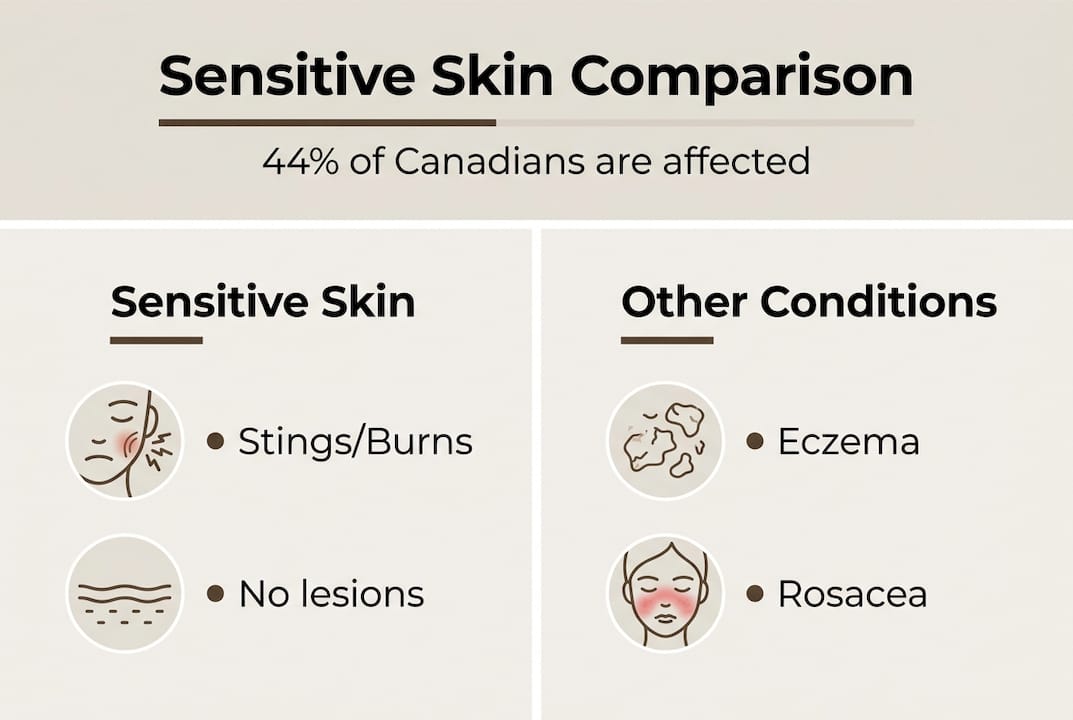
What is sensitive skin: 44% of Canadians experience it
You might assume sensitive skin always shows up as red, flaky patches or visible irritation. But here’s the truth: many Canadians experience stinging, burning, or tightness without any obvious signs on the surface. This invisible discomfort affects nearly half of all Canadians, particularly women, and it’s often misunderstood or dismissed. Understanding what sensitive skin actually is, why it happens, and how to care for it properly can transform your daily comfort and confidence. In this guide, you’ll learn the science behind sensitive skin, who’s most affected, how to identify it accurately, and which premium products truly support barrier health in Canada’s harsh climate.
Table of Contents
- Key takeaways
- What is sensitive skin and how does it affect you?
- Understanding who has sensitive skin and what influences it
- How to identify and differentiate sensitive skin from other conditions
- Effective skincare strategies and product recommendations for sensitive skin
- Explore barrier-focused skincare solutions at Body Face Scalp
- Frequently asked questions
Key Takeaways
| Point | Details |
|---|---|
| Invisible symptoms syndrome | Sensitive skin causes stinging, burning or tightness without visible lesions. |
| Barrier and nerve drivers | The condition stems from a compromised stratum corneum and hyperreactive sensory nerves, causing discomfort without surface damage. |
| Canadian prevalence among women | Nearly half of Canadians report sensitive skin symptoms, with women affected at roughly twice the rate of men. |
| Fragrance free ceramide rich care | Using fragrance free ceramide rich products helps restore barrier health. |
What is sensitive skin and how does it affect you?
Sensitive skin is defined as a syndrome characterised by unpleasant sensations such as stinging, burning, pain, pruritus, or tingling. Unlike other skin conditions, these symptoms often occur without any visible lesions or redness. You might feel discomfort when applying products, facing temperature changes, or even touching your face, yet your skin looks perfectly normal to others.
The biological reality behind this phenomenon involves two interconnected problems. First, your stratum corneum, the outermost protective layer, becomes compromised. This impaired barrier function allows increased transepidermal water loss and lets irritants penetrate more easily. Second, sensory nerves in your skin become hyperreactive, particularly through TRPV1 channels that trigger neurogenic inflammation even from mild stimuli.
Think of your skin barrier like a brick wall. When the mortar between bricks crumbles, water escapes and unwanted substances slip through. Similarly, when lipids and proteins in your stratum corneum degrade, your skin loses its protective capacity. This creates a vicious cycle: barrier damage leads to nerve exposure, which triggers inflammation, which further damages the barrier.
Common symptoms include:
- Stinging or burning sensations when applying skin care products
- Tightness or discomfort after cleansing
- Tingling or itching without visible cause
- Heightened reactivity to temperature changes
- Discomfort from fabrics, wind, or environmental factors
Biological factors driving sensitivity:
- Reduced ceramide and lipid content in the stratum corneum
- Elevated transepidermal water loss rates
- Hyperactivation of sensory nerve endings
- Increased expression of inflammatory mediators
- Compromised skin pH balance
“Sensitive skin represents a distinct syndrome where subjective discomfort occurs in the absence of objective clinical signs, driven by both barrier dysfunction and neurogenic mechanisms.”
Understanding these sensitive skin mechanisms helps you recognise why generic moisturisers often fail. Your skin needs targeted support that addresses both barrier repair and nerve calming, not just surface hydration.
Understanding who has sensitive skin and what influences it
Sensitive skin affects a substantial portion of the global population, with particularly high rates among Canadian women. Prevalence studies show approximately 50-70% of women report experiencing sensitive skin symptoms worldwide, while North American rates hover around 44%.

| Region | Prevalence | Primary demographic |
|---|---|---|
| Global | 50-70% | Women aged 18-60 |
| North America | 44% | Women, urban populations |
| Canada | 40-50% | Women, cold climate regions |
These numbers reveal that if you’re a Canadian woman experiencing skin discomfort, you’re far from alone. The condition shows clear demographic patterns, with women reporting sensitivity at roughly double the rate of men. This gender difference likely stems from hormonal influences, more frequent product use, and potentially greater awareness of subtle symptoms.
Two distinct categories exist: primary and secondary sensitive skin. Primary sensitive skin occurs without any underlying dermatological disease. It’s genetic, constitutional, and represents your skin’s inherent reactivity. Secondary sensitive skin coexists with conditions like atopic dermatitis, rosacea, or contact dermatitis, where the underlying disease amplifies sensitivity.
Canada’s harsh climate plays a significant role in triggering and worsening symptoms. Winter’s low humidity and freezing temperatures strip moisture from your skin, while indoor heating further dehydrates the stratum corneum. Summer brings UV exposure and humidity fluctuations that challenge barrier stability. This constant environmental stress makes proper barrier restoring moisturiser use essential for Canadians.
Key demographic and environmental contributors:
- Female gender and hormonal fluctuations throughout menstrual cycle
- Age-related changes in barrier lipid composition
- Urban living with pollution exposure
- Cold, dry winter climate reducing natural moisturising factors
- Genetic predisposition to barrier dysfunction
- Psychological stress amplifying nerve reactivity
- Frequent cosmetic product use increasing exposure to potential irritants
Hormones deserve special attention. Many women notice their skin becomes more reactive during menstruation, pregnancy, or menopause. Oestrogen influences barrier function, lipid synthesis, and inflammatory responses. When hormone levels fluctuate, your skin’s protective capacity and reactivity change accordingly.
Stress represents another powerful influence. Psychological stress triggers cortisol release, which impairs barrier repair and increases inflammatory mediator production. If you notice your skin reacts more during demanding periods, you’re experiencing this stress-sensitivity connection firsthand.
How to identify and differentiate sensitive skin from other conditions
Sensitive skin often gets confused with dry skin, eczema, or rosacea, but it’s fundamentally different. Dry skin primarily involves insufficient lipid content and water retention, causing flaking and roughness. Sensitive skin involves neurogenic reactivity and subjective discomfort, often without visible dryness.
Sensitive skin is not simply a progression from dry skin or eczema but a distinct neurogenic and barrier disorder. While these conditions can overlap, creating a Venn diagram of symptoms, the core mechanisms differ. Atopic dermatitis shows visible inflammation, lichenification, and immune dysregulation. Rosacea presents with persistent facial redness and visible blood vessels. Sensitive skin may show none of these objective signs yet cause significant discomfort.
Clinical diagnosis employs several validated tools. The Sensitive Skin-10 (SS-10) questionnaire asks about symptom frequency, triggers, and severity across different body areas. Diagnostic methods include the lactic acid sting test, where diluted lactic acid applied to the nasolabial fold causes stinging in sensitive individuals within minutes. Dermatologists also measure transepidermal water loss and assess barrier function through various tests.
Distinguishing signs compared to other conditions:
- Sensitive skin: discomfort without lesions, triggered by multiple factors, neurogenic origin
- Dry skin: visible flaking, roughness, improved with basic moisturisation alone
- Atopic dermatitis: eczematous lesions, intense itching, clear inflammatory markers
- Rosacea: persistent facial redness, visible vessels, papules or pustules
- Contact dermatitis: reaction to specific allergen, localised to contact area
If you’re unsure whether you have sensitive skin or another condition, consider the pattern. Sensitive skin typically reacts to multiple unrelated triggers: products, weather, stress, fabrics. Allergic contact dermatitis reacts specifically to one allergen. Rosacea shows persistent redness, not just transient discomfort. Eczema produces visible inflammation and intense itching.
Pro Tip: Keep a symptom diary for two weeks, noting when discomfort occurs, what you applied or encountered beforehand, and how long symptoms lasted. This pattern recognition helps you and your dermatologist distinguish sensitive skin from other conditions and identify your specific triggers. Track weather conditions, stress levels, and menstrual cycle alongside product use for comprehensive insight.
Self-assessment remains valuable, but professional evaluation provides definitive diagnosis. If symptoms significantly impact your quality of life, persist despite skin care changes, or worsen over time, consult a dermatologist. They can perform patch testing, barrier function assessment, and rule out underlying conditions requiring specific treatment.
Effective skincare strategies and product recommendations for sensitive skin
Caring for sensitive skin requires a strategic approach focused on barrier repair, irritant avoidance, and ingredient integrity. Generic products marketed for “sensitive skin” often contain hidden irritants or lack the specific components needed for true barrier restoration.
Ingredient integrity matters profoundly. Fragrance-free, ceramide-rich products with hyaluronic acid and niacinamide help restore the skin barrier and reduce neurogenic reactivity. These ingredients work synergistically: ceramides rebuild lipid structure, hyaluronic acid binds water in the stratum corneum, and niacinamide reduces inflammation while supporting barrier protein synthesis.
| Ingredient | Primary benefit | Mechanism | Avoid if |
|---|---|---|---|
| Ceramides | Barrier repair | Replenishes lipid matrix between corneocytes | Never, essential for sensitive skin |
| Hyaluronic acid | Hydration | Binds 1000x its weight in water | Very rare sensitivity |
| Niacinamide | Anti-inflammatory | Reduces cytokine production, supports barrier lipids | Concentration above 10% may irritate |
| Fragrance | None, pure irritant | Triggers sensory nerves and allergic responses | Always avoid |
| Alcohol (denat.) | None for sensitive skin | Strips lipids, increases TEWL | Always avoid |
Your skincare routine should follow these evidence-based steps:
- Gentle cleansing with non-foaming, pH-balanced cleansers that preserve barrier lipids
- Immediate hydration application while skin remains damp to trap moisture
- Barrier restoring moisturiser containing ceramides, cholesterol, and fatty acids in physiological ratios
- Targeted treatment with skin correcting serum for hyperpigmentation or specific concerns
- Broad-spectrum mineral sunscreen daily, even in winter, using zinc oxide or titanium dioxide
- Evening application of multi peptide serum to support barrier repair overnight
Premium brands recommended in Canada include SkinCeuticals, La Roche-Posay, and CeraVe, available at Sephora and Shoppers Drug Mart. However, many Canadians seeking truly premium, barrier-focused formulations turn to specialised brands that prioritise ingredient science over marketing.
Pro Tip: When introducing any new product, perform a patch test on your inner forearm for 48 hours before facial application. Even products formulated for sensitive skin can trigger individual reactions. Introduce one new product every two weeks, allowing time to assess tolerance and identify any problematic ingredients. This methodical approach prevents confusion if sensitivity occurs.
Canadian winter demands additional protection. Layer a heavier occlusive moisturiser over your regular barrier cream when heading outdoors. Look for products containing squalane, shea butter, or dimethicone to create a protective seal against harsh wind and cold. Indoor humidity control also helps; aim for 40-50% relative humidity to prevent excessive transepidermal water loss.
Avoid common irritants entirely: fragrance, essential oils, alcohol denat., harsh surfactants like sodium lauryl sulphate, and physical exfoliants. Chemical exfoliation should be approached cautiously, using only gentle lactic acid or PHA formulations once weekly at most. Your skin needs consistent support, not aggressive treatment.
Dermatologist recommended moisturisers typically contain minimal ingredients, focusing on proven barrier-repair components rather than trendy botanicals. Simpler formulations reduce the risk of unexpected reactions while delivering targeted benefits.
Explore barrier-focused skincare solutions at Body Face Scalp
If you’re ready to move beyond generic sensitive skin products and invest in scientifically-formulated barrier repair, Body Face Scalp offers premium solutions designed specifically for Canadian climate challenges. Our barrier restoring moisturiser combines physiological lipid ratios with ceramides and nourishing botanicals to rebuild compromised barriers while calming neurogenic reactivity.

The skin correcting serum addresses hyperpigmentation and uneven tone without irritation, using gentle yet effective ingredients suitable for reactive skin. For comprehensive barrier support, explore our complete premium skin care collection, where every formulation prioritises ingredient integrity, fragrance-free composition, and dermatological testing. Each product supports the interconnected system of body, face, and scalp health, recognising that true skin wellness requires holistic care.
Frequently asked questions
What are the common triggers of sensitive skin?
Common triggers include harsh cleansers containing sulphates, synthetic fragrances and essential oils, cold and dry climate conditions, psychological stress, and hormonal fluctuations during menstrual cycles or menopause. Environmental factors like wind, pollution, and rapid temperature changes also provoke symptoms. To minimise reactions, avoid products with alcohol, fragrances, and abrasive exfoliants. In Canadian winters, wear layered clothing and apply barrier creams before outdoor exposure to protect against harsh conditions.
How can I tell if my skin is sensitive or if I have a condition like eczema?
Sensitive skin causes discomfort like stinging, burning, or tightness without visible lesions or inflammation. Eczema typically shows objective signs including red, inflamed patches, intense itching, and sometimes weeping or crusting lesions. If you experience discomfort without visible changes and react to multiple unrelated triggers, you likely have sensitive skin. However, if symptoms persist despite gentle skincare changes, worsen over time, or show visible inflammation, consult a dermatologist for proper diagnosis and treatment.
Are natural or organic products better for sensitive skin?
Natural or organic products aren’t automatically better for sensitive skin and can still cause irritation if they contain allergens like essential oils, plant extracts, or natural fragrances. Many botanical ingredients trigger reactions in sensitive individuals despite being “natural.” Instead of focusing on natural versus synthetic, look for fragrance-free, ceramide-rich formulations backed by clinical research. Ingredient science matters more than marketing claims. Products with proven barrier-repair components like ceramides, niacinamide, and hyaluronic acid deliver better results regardless of natural certification.
Can sensitive skin improve over time?
Yes, sensitive skin can improve significantly with proper care and consistent trigger avoidance. By using barrier-repair products containing ceramides and avoiding irritants, you can restore lipid structure and reduce transepidermal water loss over weeks to months. Neurogenic sensitivity also decreases as barrier function improves and inflammatory mediators reduce. However, improvement requires sustained commitment to gentle skincare, environmental protection, and stress management. Genetic predisposition remains, so maintenance care continues long-term even after symptoms improve.
Recommended
- Barrier-Focused Skincare | Canadian Barrier Repair Skincare Brand – Body Face Scalp
- Skin Care – Body Face Scalp
- Skincare – Body Face Scalp
- The Ultimate Guide to Barrier Restoring Moisturizer: What It Is, Why Y – Body Face Scalp
- Understanding Sensitive Skin Care: What You Need to Know - Eneleo - Natural Skin Care
- Sensitive Haut – Was Betroffene Unbedingt Beachten Müssen – Kühlkern UG (Haftungsbeschränkt)